
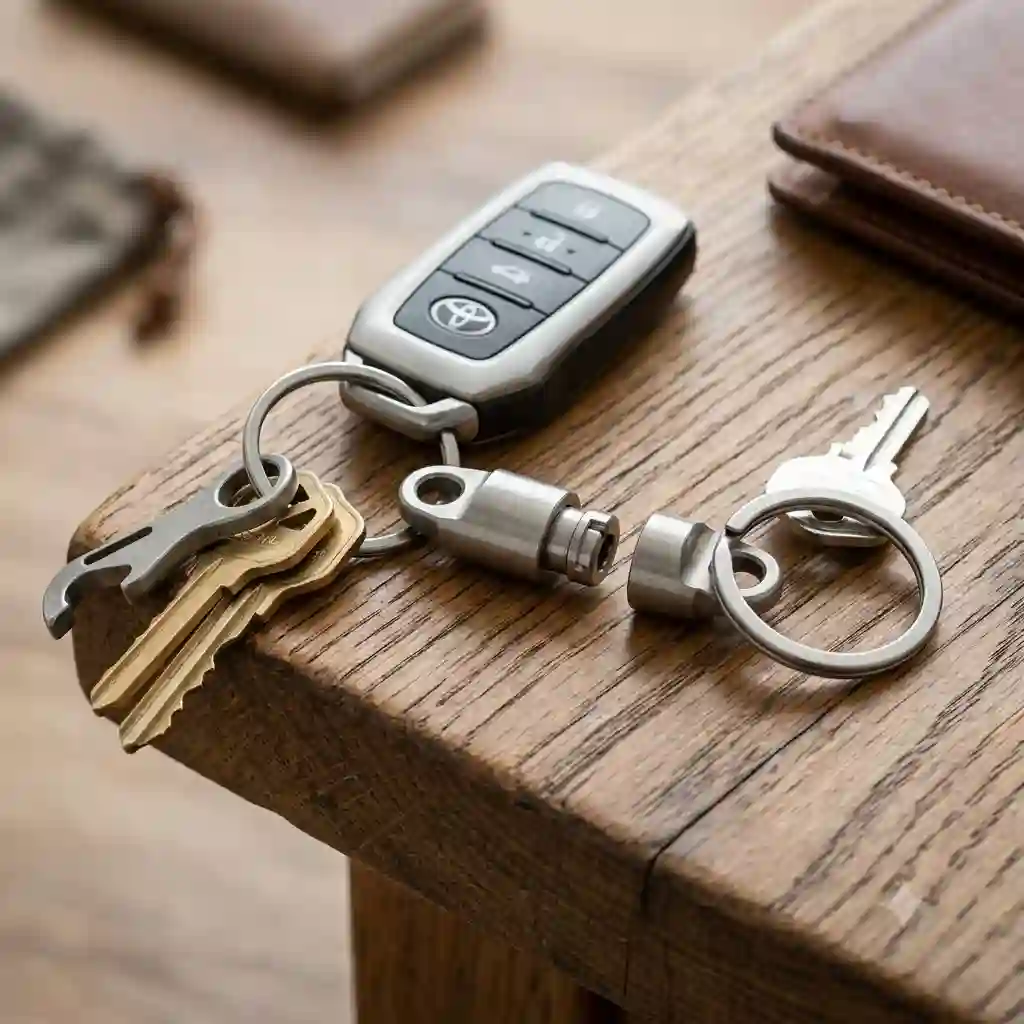
What is a quick release key ring? In its simplest form, it is an everyday carry (EDC) hardware mechanism designed to rapidly separate two sets of keys or tools while maintaining a secure, accidental-drop-proof connection when engaged. After 10+ years of optimizing everyday carry systems and field-testing hundreds of gear configurations, I can tell you that the right separation mechanism is the literal linchpin of your daily workflow.
Most beginners assume any cheap magnet or standard carabiner will do the job. However, in my field tests, relying on sub-par metal alloys inevitably leads to structural fatigue, gate failure, and ultimately, lost keys. A high-quality quick release key ring solves a specific ergonomic problem: handing off a vehicle key to a mechanic, detaching a specific key for an electronic access control panel, or removing extra bulk when throwing your fob into a gym bag.
What surprised me most during extended use was how the tactile feedback of a premium mechanism actually creates a psychological sense of security. You aren’t just buying metal; you’re buying the confidence that your $400 electronic vehicle fob won’t end up at the bottom of a storm drain. In this guide, we dive deep into the engineering, practicality, and real-world performance of the market’s top options.
Quick Comparison: Top quick release key rings Evaluated
| Model | Primary Material | Separation Mechanism | Best For | Price Range |
| Nite Ize S-Biner MicroLock | Stainless Steel | Twist-to-lock double gate | Budget EDC | Under $10 |
| Prometheus Lights Kappa | Titanium / Brass | Canted coil spring | Premium Minimalists | $25 – $35 |
| KEY-BAK Sidekick | Polycarbonate / Kevlar | Retractable tether | Heavy Duty / Work | $15 – $20 |
| Tec Accessories Python | 300 Series Stainless | Tension gate | Low-Profile Carry | $10 – $15 |
| MecArmy CH2 | TC4 Titanium | Anti-lost screw / D-ring | High-End Fobs | $15 – $25 |
Looking at the comparison above, the Nite Ize S-Biner MicroLock delivers the best value under $10, but if sheer retention strength without moving parts is your priority, the Prometheus Lights Kappa‘s canted coil spring justifies the higher price tag. Budget buyers should note that retractable options like the KEY-BAK Sidekick sacrifice minimalist aesthetics for pure functional reach, making them highly specific to workplace environments rather than pocket carry.
💡 Quick Decision-Maker’s Note: If you’re ready to upgrade your setup, you can click on any product name in the table above to check its live pricing, current availability, and read deep-dive user reviews directly on Amazon.
[addtoany]
Top 5 Quick Release Key Rings — Expert Hands-On Analysis
1. Nite Ize S-Biner MicroLock
The Nite Ize S-Biner MicroLock utilizes a dual-spring gate system locked by a central rotating polymer dial, rated for a 3-pound load limit. This means you can confidently hang your heavy car fob and house keys off a belt loop without worrying that a rogue branch or seatbelt will depress the gate and dump your keys. Instead of a traditional pull-apart mechanism, this functions as an ultra-secure joining link that takes less than a second to operate once you build the muscle memory.
In my experience, what most buyers overlook about this model is the sheer utility of the dual-sided nature. I use one side permanently affixed to my belt loop, leaving the bottom gate exclusively for detachment. This prevents the awkward fumbling associated with single-gate carabiners. It is absolutely perfect for the budget-conscious daily commuter, though I would advise against using it for heavy-duty industrial environments where grit might seize the central plastic locking dial.
Community feedback consistently praises the MicroLock for punching well above its weight class in the under $10 price range. A few reviewers note that the black oxide finish chips after six months, but in practice, I found this purely cosmetic and unimpactful on the structural integrity. If you want maximum security on a strict budget, this is the definitive entry point into EDC organization.
-
Pros: Extremely affordable, physical locking mechanism, dual gates for independent attachment.
-
Cons: Finish wears off quickly, central lock can stiffen in freezing weather.
2. Prometheus Lights Kappa Quick Release
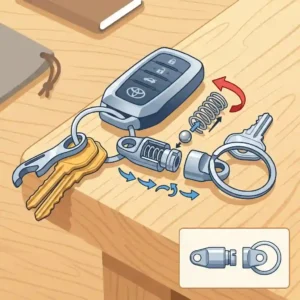
When you step up to the Prometheus Lights Kappa, you are trading mechanical gates for advanced physics—specifically, a canted coil spring mechanism boasting 10 lbs of pull strength. This translates to a seamless, snap-apart action that requires intentional, linear force to separate, but zero moving parts that can break or jam. If you have ever suffered the frustration of a stuck carabiner gate because of pocket lint or sand, this friction-fit technology is a game-changer.
This model is explicitly designed for the premium EDC enthusiast and the modern professional. The titanium or brass construction not only looks akin to high-end jewelry but resists corrosion entirely. My insider tip: applying a micro-drop of Nano-Oil to the inner track every six months keeps the snap action incredibly satisfying. It is perfect for those who frequently detach a car fob from a house key cluster, as the low-profile design adds almost no bulk to your pocket.
Users across EDC forums revere the Kappa for its “fidget-factor” and flawless reliability, easily validating its $25-$35 price range. While some balk at paying this much for a tiny piece of hardware, the total cost of ownership is effectively zero after the initial purchase, as it will genuinely outlast the keys attached to it.
-
Pros: Indestructible design, incredibly satisfying tactile snap, zero moving parts to fail.
-
Cons: Premium price point, requires linear force which takes a day to get used to.
3. KEY-BAK Sidekick
The KEY-BAK Sidekick deviates from traditional static rings by offering a retractable 24-inch Kevlar cord tether with an 8-ounce retraction force. In real-world terms, this means you can secure a heavy cluster of up to 15 keys to your hip and reach the lock on your front door without unhooking anything. The quick-release aspect here is the carabiner-style top clip and the twist-free end fitting, allowing for rapid deployment when full detachment is necessary.
I heavily recommend this for facility managers, teachers, and security personnel. The spec sheet won’t tell you this, but the polycarbonate housing acts as an acoustic dampener; unlike all-metal retractors, it doesn’t loudly clank against desks or chairs when you sit down. The Kevlar cord is incredibly resistant to fraying, though I’ve found that exposing it to sharp, abrasive edges repeatedly will eventually compromise the sheath.
Given it generally sits in the $15-$20 range, the community consensus is that KEY-BAK remains the undisputed king of tethered systems. Most reviewers claim the carabiner spring is the first thing to wear out, but in practice, I found regular cleaning of the housing prevents the grit buildup that usually causes that tension loss.
-
Pros: Massive reach via Kevlar cord, holds substantial weight without sagging, durable housing.
-
Cons: Bulky on the belt, not suitable for minimal pocket carry.
4. Tec Accessories Python Clip
The Tec Accessories Python Clip is a masterclass in tension-based minimalist engineering, crafted entirely from 300 series stainless steel. Operating much like a wire-gate carabiner but highly miniaturized, it relies on the natural spring tension of the bent steel to keep the gate closed. Because it lacks a hinge pin, there is virtually zero risk of the gate becoming misaligned—a massive practical benefit if you frequently clip your quick release key ring to thick leather belt loops that normally warp cheaper clips.
For the minimalist who counts every gram of pocket weight, the Python is my top recommendation. It is exceptionally discreet. However, the lack of a secondary locking feature means it is best suited for inside-the-pocket suspension rather than external bag carry. If you use pocket organizers or internal backpack loops, this clip allows for instant, blind detachment with one hand.
In the $10-$15 bracket, actual customer reviews highlight its sleek aesthetics and corrosion resistance. The only real world issue I’ve encountered—and one echoed by a minority of users—is that the gate opening is relatively narrow. You will struggle to clip this onto D-rings thicker than 4mm.
-
Pros: Ultra-lightweight, no hinge pins to break, incredibly sleek aesthetic.
-
Cons: Narrow gate clearance, lacks a secondary locking mechanism.
5. MecArmy CH2 Titanium Key Ring
The MecArmy CH2 bridges the gap between a traditional split ring and a quick-release system via a heavy-duty, anti-lost screw D-ring design, machined from TC4 Titanium alloy. The practical interpretation here is unmatched security: instead of prying open a fingernail-breaking split ring, you unscrew the crossbar, load your thick automotive fobs, and screw it back down.
While it isn’t a “rapid pull” release like the Kappa, it is the safest intentional release system I’ve tested. I specifically recommend this for modern car fobs with thick plastic mounting holes that refuse to sit flat on traditional circular rings. The D-shape allows bulky fobs to articulate freely. My insider advice: use a tiny dab of blue threadlocker on the screw if you are taking it on a long hiking trip to ensure vibrations don’t back the pin out.
Priced in the $15-$25 range, users universally praise the CH2 for saving their fingernails and securing wildly expensive smart keys. While it requires two hands to operate, the trade-off for absolute peace of mind is well worth the extra five seconds of detachment time.
-
Pros: Absolute security, accommodates thick fobs easily, high-end titanium construction.
-
Cons: Requires two hands and a few seconds to detach, screw can be lost if dropped in grass.
🔍 Ready to Upgrade Your Everyday Carry Setup?
Streamlining your pockets isn’t just about reducing weight; it’s about preserving your time, securing expensive vehicle fobs, and removing the daily friction of fumbling at your front door. Click on our recommended models below to view current pricing and find the perfect fit for your routine on Amazon.
Practical Usage Guide: Setting Up Your EDC Key System
Purchasing a premium quick release key ring is only half the battle; integrating it optimally into your routine dictates its actual value. During your first 30 days of use, the goal is to establish muscle memory and compartmentalize your carry.
Step 1: The Audit & Purge
Before attaching your new hardware, remove every key you haven’t used in the last 60 days. The efficiency of a quick-release system is destroyed by unnecessary bulk.
Step 2: The Two-Tier System
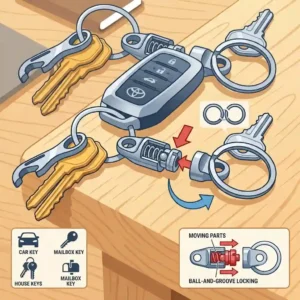
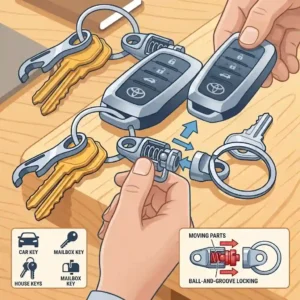
I always recommend a “Base” and a “Satellite” configuration. Your Base—usually a heavy-duty carabiner or the top half of your quick release—holds essential, everyday items like your car key and house key. The Satellite—attached via the quick release mechanism—holds situational items: mail keys, gym tags, or a multi-tool. This allows you to instantly shed weight when you go for a run, leaving the bulky items in your vehicle.
Step 3: The 6-Month Maintenance Cycle
Metal-on-metal friction inevitably creates wear. For spring-loaded gates, a quick blast of compressed air followed by a dry PTFE lubricant keeps the action snappy. Avoid wet oil-based lubricants, as they attract pocket lint and accelerate internal grinding. For threaded mechanisms like the MecArmy CH2, check the threading monthly for cross-threading or grit buildup.
Real-World Scenarios: Matching Your Ring to Your Lifestyle
Not every five-star product works for every person. The “perfect” product can fail miserably if placed in the wrong edge-case scenario. Let’s break down matching the hardware to the human.
The Commuter & Office Worker
If you drive to a train station, commute into the city, and use a keycard to enter your building, you need silent, low-profile gear. The Prometheus Lights Kappa is ideal here. Its snap-action allows you to detach your car key to leave with a valet or spouse, while keeping your office fob securely in your pocket. A clunky carabiner would ruin the lines of your professional attire.
The Industrial Worker / Contractor
If you wear heavy gloves and access multiple padlocks daily, the KEY-BAK Sidekick is your champion. The anti-recommendation here is the Tec Python—if you are wearing work gloves, you will absolutely lack the tactile dexterity to manipulate a tiny wire gate. You need macro-ergonomics: big tethers and large retention clips.
The Fitness Enthusiast
For those who transition from the office to the gym, the Nite Ize S-Biner MicroLock shines. You can lock the primary side to your gym bag, detach your locker key via the secondary gate, and lock it to your water bottle strap. It provides modularity that static rings simply cannot match.
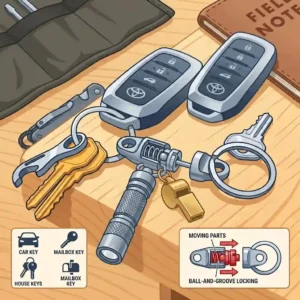
Common Problems and Quick Fixes for Key Detachment
Even the best EDC gear encounters real-world friction. Here are the most common problems buyers face and exactly how to fix them.
Problem 1: The “Jingle” Effect
When you upgrade to titanium or heavy steel rings, the acoustic clatter of keys hitting the hardware increases.
-
The Solution: Integrate micro rubber O-rings between each key on the main split ring, or use a leather key organizer (like a Bellroy or KeySmart) on the bottom half of your quick release key ring. This compresses the keys, eliminating 90% of the noise.
Problem 2: Accidental Gate Deployment
You sit down, your pocket bunches up, and the gate on your tension clip is depressed, dropping your keys into the couch cushions.
-
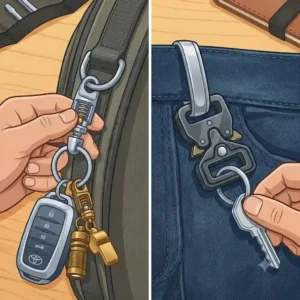
The Solution: If you refuse to use locking gates, change your carry geometry. Move tension clips to a suspension setup (hanging vertically down inside the pocket edge) rather than horizontal belt loops. This removes lateral pressure on the gate.
Problem 3: Stiff or Gritty Mechanisms
After a day at the beach or a dusty job site, ball-detent mechanisms seize up.
-
The Solution: Do not force it. Submerge the mechanism in warm, soapy water and actuate it repeatedly. Dry thoroughly with a hairdryer, then apply a dry graphite powder.
How to Choose the Perfect quick release key ring
Selecting the right hardware is a balance of physical engineering and your personal daily workflow. Use this expert framework:
-
Assess the Load Weight: Are you carrying three lightweight brass keys, or a massive Ford F-150 fob, a brass flashlight, and a pry tool? Heavy loads require locking gates or heavy-duty canted coils.
-
Evaluate the Handoff Frequency: How many times a day do you detach the keys? If it’s more than three times (e.g., mail delivery, security rounds), prioritize friction-fit systems over screw-locks to save time and finger strain.
-
Check the Attachment Points: Look at the eyelet on your car fob. Modern fobs have incredibly thick plastic housings. A traditional ring will bind and snap the plastic. You must ensure the quick release key ring you choose features an appropriately sized D-ring or secondary split ring to allow the fob to hang naturally.
-
Determine the Environment: If you work near saltwater or heavy humidity, titanium and 300-series stainless steel are non-negotiable requirements to prevent rust.
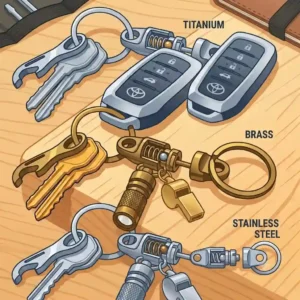
Material Science: Titanium vs. Stainless Steel vs. Brass
The spec sheet won’t tell you this, but the alloy you choose dictates not just durability, but how the hardware ages in your pocket.
Titanium (TC4/Grade 5): According to metallurgical data from high-authority sources like Wikipedia’s breakdown of Titanium alloys, Grade 5 Titanium offers a phenomenal strength-to-weight ratio and absolute corrosion resistance. In a pocket environment—which is highly acidic due to human sweat—titanium remains structurally perfect. It is exceptionally light, but it is prone to surface scratching (snail trails).
Stainless Steel (304/316): The workhorse of the EDC world. It is heavier than titanium, providing a reassuring heft. It has excellent spring memory, making it ideal for wire gates. However, “stainless” does not mean “stain-free.” Cheaper 400-series steels will develop surface rust if left in damp environments.
Brass and Copper: Chosen purely for aesthetics and antimicrobial properties. These materials are heavily dense and incredibly soft compared to steel. They will deform under high load and naturally develop a dark patina. Choose these only if you are curating a specific vintage aesthetic for light-duty carry.
The Real Cost of Losing Your Keys: Security vs. Convenience
We often focus on the convenience of a quick release key ring, but its primary function is security. According to physical security guidelines from government entities like CISA.gov, compromised physical access controls (lost keys) remain a leading vector for property theft.
The hidden cost of a cheap key ring failing isn’t the $2 you spent on it. The true “Total Cost of Ownership” in a failure scenario includes towing your vehicle, paying a dealership $350+ to reprogram a new smart fob, and potentially paying a locksmith $200 to re-key your home if your ID was attached. Investing $25 in a failure-proof titanium mechanism is incredibly cheap insurance against a $500+ disaster. You are paying to close the “Efficiency Gap” between cheap hardware and absolute reliability.
Common Mistakes When Buying Everyday Carry Hardware
Mistake 1: Ignoring Gate Clearance
The most frequent return reason for carabiner-style rings is that the gate doesn’t open wide enough to fit over the user’s favorite thick leather belt. Always check the millimeter clearance of the gate opening.
Mistake 2: Overloading Friction Systems
Friction-fit pull-apart rings are fantastic, but they have a static weight limit. If you attach a heavy 16oz water bottle to one end and step down hard off a ledge, the G-force can cause the ring to pop open. Match the tool to the task.
Mistake 3: The “Tacticool” Trap
Many buyers purchase aggressively styled, overly complex mechanisms with unnecessary moving parts because they look cool online. In reality, complex gear has more failure points. True EDC experts lean toward elegant, minimalist designs that rely on physics (like tension or coil springs) rather than complex latches that can snap.
Quick Release vs. Traditional Split Rings: A Mechanical Breakdown
| Feature | Traditional Split Ring | Quick Release Mechanism |
| Time to Detach | 15-30 seconds | 1-3 seconds |
| Finger Strain | High (Requires prying) | Low to Zero |
| Wear on Keys | High (Scratches upon entry) | Minimal |
| Complexity / Failure Points | None (Static piece) | Low to Moderate (Springs/Gates) |
Looking at this mechanical breakdown, traditional split rings win on absolute simplicity and baseline security—they simply cannot accidentally open. However, their total lack of modularity makes them a nightmare for modern fobs. A high-quality quick release key ring solves the ergonomic disaster of the split ring, saving your fingernails and massive amounts of time, provided you invest in a model with a reliable retention system to offset the introduced mechanical failure points.
Conclusion
Mastering your daily carry is about removing friction from your life. A premium quick release key ring transitions your pocket setup from a chaotic, jingling mess into a streamlined, highly functional system. Whether you opt for the budget-friendly locking dual-gates of the Nite Ize, the premium friction-fit physics of the Prometheus Kappa, or the heavy-duty utility of the KEY-BAK, the right tool exists for your specific lifestyle.
Remember that everyday carry hardware is an investment in security and peace of mind. Stop trusting your most valuable physical access tools to cheap, generic carabiners that warp after a month of use. Audit your keys, choose the correct material for your environment, and elevate your daily workflow.
FAQs
❓ What is the weight capacity of a standard quick release key ring?
✅ Premium models like the Prometheus Kappa hold up to 10 lbs of static weight, while heavy-duty tethers like KEY-BAK can retract 8-15 oz. Always verify the manufacturer’s specific rating, as exceeding it risks accidental deployment…
❓ Are magnetic key rings safe for electronic fobs and credit cards?
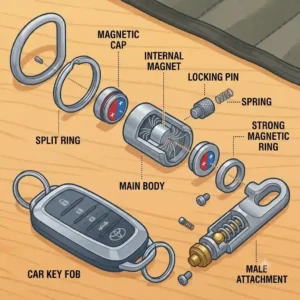
✅ Yes, modern neodymium magnetic rings are generally safe for vehicle fobs. However, keep them at least an inch away from older magnetic stripe credit cards or hotel room keys to prevent accidental demagnetization…
❓ How do I maintain the spring in my EDC carabiner?
✅ Avoid wet oils. Clean the mechanism with compressed air every few months, followed by a dry PTFE or graphite powder lubricant. This prevents pocket lint and grit from binding the spring action…
❓ Can a quick release key ring be taken through TSA security?
✅ Yes, as long as it does not feature a concealed blade, glass breaker, or knuckle-duster design. Standard titanium or steel mechanical rings pass through airport security scanners without issue globally…
❓ Why do some titanium key rings change color over time?
✅ Titanium does not rust, but it can anodize naturally through exposure to the heat and oils in your hands, creating a slight patina. This is a harmless surface-level oxidation that adds unique character to the metal…
Recommended for You
- 5 Expert Tips to Find the Best leather keychain holder in 2026
- Top 5 Best leather key ring holder Picks for 2026: An Expert’s Guide
- 5 Best Leather Keychain Wallet Picks: 2026 Expert EDC Guide
Disclaimer: This article contains affiliate links. As an Amazon Associate, I earn from qualifying purchases. If you purchase products through these links, we may earn a small commission at no additional cost to you.
✨ Found this guide helpful? Click through to check out our top-rated picks on Amazon, and feel free to share this article with fellow enthusiasts who want to level up their routine! 💬🤗
[addtoany]
