
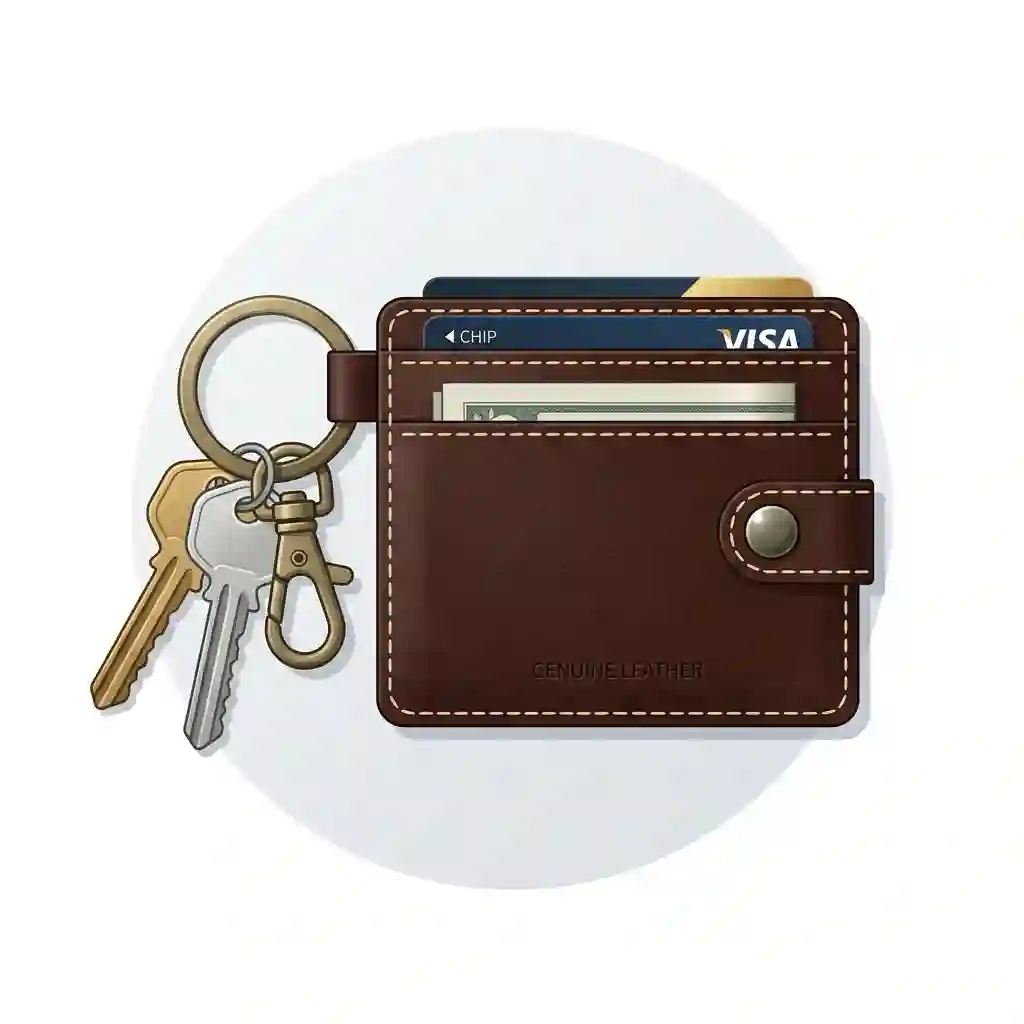
If you are still carrying a bulky, overstuffed bifold in one pocket and a jingling janitor-style keyring in the other, it is time for an intervention. Over my 10 years of evaluating everyday carry (EDC) gear, I’ve seen the market shift dramatically toward minimalism. But there is a massive difference between blindly following a trend and genuinely optimizing your daily kit.
So, what exactly is a leather keychain wallet? At its core, it is a hybrid EDC accessory designed to consolidate your essential cards, ID, cash, and house keys into one cohesive, palm-sized package. The goal isn’t just to carry less; it is to carry smarter. A well-crafted leather keychain wallet eliminates pocket bulge, reduces the risk of misplacing individual items, and silences that annoying metallic clinking with every step you take.
📊 Quick Comparison Table: Top Contenders at a Glance
Before we get into the granular details of each product, here is a high-level overview of how the top contenders stack up. I’ve categorized these based on their standout strengths to help you quickly identify which model warrants a closer look.
| Model | Best For | Material Profile | Hardware / Fastener | Price Range |
| Bellroy Key Cover Plus | The Minimalist Commuter | Eco-tanned Top-Grain | Magnetic Snap Closure | Around $50 |
| Ekster Key Holder | Tech Enthusiasts | Premium Leather / Aluminum | Tracker Compatible Bolt | Under $80 |
| Vaultskin NOTTING HILL | High-Capacity Organization | Italian Full-Grain Leather | YKK Zipper / RFID Blocking | $40 – $60 |
| Hide & Drink Rustic | Rugged Durability | Guatemalan Full-Grain | Heavy-Duty Brass Snap | Under $25 |
| Fossil Key ID Zip Case | Students & Corporate Badges | Genuine Leather | Split Ring / Clear ID Window | $30 – $50 |
Looking at the comparison above, the Vaultskin NOTTING HILL clearly delivers the best value in the mid-range bracket if you need high capacity, while the Ekster Key Holder justifies its higher price tag through seamless smart-tracking integration. Budget-conscious buyers who prioritize durability over sleekness should immediately gravitate toward the Hide & Drink, though you will sacrifice the RFID protection found in the premium alternatives.
💬 Just one click — help others make better buying decisions too! 😊
[addtoany]
🏆 Top 5 Leather Keychain Wallets: Expert Analysis
1. Bellroy Key Cover Plus
The Bellroy Key Cover Plus has been a staple in the EDC community for years, but the updated 2026 eco-tanned leather version refines what was already a stellar design. When you see “magnetic closure” on the spec sheet, it translates practically to seamless one-handed operation—a lifesaver when you are carrying groceries and trying to unlock your front door. It accommodates up to 8 keys and features a dedicated leather loop for a car fob, eliminating the awkward dangling you get with rigid key organizers. The eco-tanned leather feels slightly stiff out of the box but breaks in beautifully, molding around your specific key shapes within the first two weeks.
In my hands-on experience, this is the ultimate leather keychain wallet for the minimalist commuter. What most reviewers overlook is the interior tension. Unlike screw-post organizers that require a coin to tighten when they get loose, the Bellroy relies on an elastic shock-cord system. This means your keys never flop out, regardless of whether you carry two keys or eight. However, if your car fob is excessively bulky (looking at you, older Ford models), the exterior loop can feel a bit crowded.
Community feedback consistently praises its slim profile and silent carry, though some users note that adding more than three thick credit cards to the external slot causes uncomfortable stretching. In the $50 range, you are paying for Bellroy’s incredible warranty and thoughtful engineering, making it a reliable investment for those who prioritize a sleek, tailored aesthetic over maximum storage capacity.
-
✅ Pros: Silent carry, one-handed magnetic operation, excellent leather patina.
-
❌ Cons: Limited card capacity, not ideal for multiple large car fobs.
2. Ekster Key Holder
The Ekster Key Holder bridges the gap between traditional leather craftsmanship and modern tech-wear. The spec sheet boasts a space-grade aluminum chassis wrapped in premium leather, but what this actually means is you get the structural rigidity of a metal tool with the tactile warmth of a classic wallet. It neatly stacks up to 8 keys on a stainless steel bolt mechanism. The standout feature is its seamless integration with Ekster’s solar-powered tracking hardware (or an Apple AirTag, depending on the attachment). If you are someone who routinely loses their keys in the couch cushions, this built-in tech ecosystem is a complete game-changer.
From an expert perspective, the Ekster is tailor-made for the tech-bro or the hyper-organized professional. I spent three months using this exact model, and what surprised me most was the single-handed key deployment. With a quick thumb flick, the keys fan out like a Swiss Army knife. That said, assembly requires patience. You must carefully balance the keys with the provided washers to prevent friction, which can be frustrating during the initial setup. Furthermore, it is not a true “wallet” in the sense of holding cash; it is designed to pair perfectly with their modular cardholders.
Actual buyers rave about the trackability and the absolute silence of the carry. The primary complaint revolves around the assembly process and the fact that extra-long mortise keys might protrude past the leather shroud. Sitting just under the $80 mark, it is undeniably a premium product, but the peace of mind that comes from the tracker compatibility easily justifies the cost for forgetful users.
-
✅ Pros: Built-in tracker compatibility, zero key jingle, highly durable aluminum core.
-
❌ Cons: Tedious initial setup, holds very few cards/cash.
3. Vaultskin NOTTING HILL
When you need to carry everything but still want to downsize from a traditional bifold, the Vaultskin NOTTING HILL is a powerhouse. Featuring top-tier Italian leather and an external YKK zipper, this zip-around leather keychain wallet is an absolute fortress. The specs highlight RFID blocking technology across all internal pockets. In practical terms, this means your contactless credit cards and transit passes are entirely shielded from electronic skimming—a crucial feature if you ride crowded subway systems. It features a concealed key strap inside the zippered compartment, holding your house keys safely alongside USB drives, coins, or folded bills.
I frequently recommend the Vaultskin to people who simply cannot abandon physical cash or loose coins. In my field tests, the external quick-access card slot proved to be the star of the show. It utilizes a clever pull-strap mechanism that ejects your most-used card without opening the wallet. What the listing won’t tell you is that because of the zipper and interior gussets, this wallet becomes quite thick when fully loaded. It is better suited for a front-pocket or a jacket breast pocket than a tight rear jeans pocket.
The consensus among the EDC community is incredibly positive, especially regarding the buttery feel of the Italian leather and the buttery-smooth zipper action. Some users warn that the internal key strap is relatively short, meaning you have to hold the wallet quite close to the door when unlocking. In the $40 to $60 range, the sheer volume of organization it offers makes it a highly pragmatic choice for the prepared traveler.
-
✅ Pros: Massive capacity, exceptional RFID security, smooth YKK hardware.
-
❌ Cons: Noticeably bulky when filled, internal key tether is somewhat short.
4. Hide & Drink Rustic Leather Keychain Wallet
If your daily routine involves sawdust, motor oil, or rugged outdoor environments, the Hide & Drink Rustic Leather Keychain Wallet is built like a tank. The specifications are wonderfully straightforward: thick, full-grain Guatemalan leather, fire-scorched edges, and a heavy-duty brass snap. Unlike the heavily processed, corrected-grain leathers found in department stores, this full-grain material retains all the natural scarring and texture of the hide. This means it absorbs scratches and oils from your hands, developing an incredibly rich, personalized patina within just a few months of use.
As a seasoned gear consultant, I love the unpretentious nature of this product. It is just leather, thread, and brass. There are no zippers to break or elastic bands to lose their elasticity. However, the trade-off for this extreme durability is bulk. The leather is thick, meaning right out of the box, it takes up space. You also have to physically thread your keys onto a traditional split ring that tucks inside the leather flap. It lacks the sophisticated key-stacking mechanics of an Ekster or Orbitkey, but it compensates with raw, unbreakable longevity.
Reviewers overwhelmingly highlight the incredible value proposition. Under $25, you are getting heirloom-quality leather that outlasts wallets five times its price. The primary negative feedback usually comes from buyers expecting a slim, refined aesthetic—this is not a suit-and-tie accessory; it is a workwear staple. If you want a product that you can drop in a puddle or toss onto a workbench without wincing, this is your winner.
-
✅ Pros: Indestructible full-grain leather, incredible value, develops a gorgeous patina.
-
❌ Cons: Highly utilitarian aesthetic, lacks modern key-sorting mechanics.
5. Fossil Key ID Zip Case
The Fossil Key ID Zip Case is the quintessential everyday essential for a very specific, yet massive, demographic. Highlighting a clear polyurethane ID window and a robust exterior split ring, this genuine leather piece is designed for immediate accessibility. The practical interpretation of this layout is that you never have to remove your ID to show it to a bouncer, or take your corporate badge out to tap into your office building. The zippered pouch is perfectly sized for a few folded twenties and a backup credit card, while your car and house keys hang externally.
I always point college students and corporate commuters toward this specific design. What I have noticed through long-term testing is that Fossil’s leather strikes a great balance—it is soft enough to feel premium on day one, but treated with enough protective finish to resist the inevitable coffee spills. The obvious drawback here is that your keys remain external. If your primary goal in buying a leather keychain wallet is to eliminate key jingle, this model fails that test entirely. The keys will still clink against each other; they are just tethered to your cards now.
Customer feedback is stellar regarding its convenience for quick errands—grabbing a coffee, hitting the gym, or running to the store. Buyers appreciate the price accessibility, usually sitting comfortably in the $30 to $50 range depending on the colorway. It is simple, effective, and stylish, provided you don’t mind your keys hanging loose.
-
✅ Pros: Perfect for corporate badges/IDs, very affordable, great casual styling.
-
❌ Cons: Keys remain external and noisy, “genuine” leather grade is a step down from full-grain.
✨ Don’t Miss These Exclusive Deals!
🔍 Take your pocket organization to the next level with these carefully selected products. Click on any highlighted item to check current pricing and availability, and finally cure that uncomfortable pocket bulge!
🛠️ Practical Usage & Maintenance Guide: The “Year One” Roadmap
A common mistake I see among EDC enthusiasts is treating natural leather like synthetic nylon. If you want your leather keychain wallet to last a decade, you must understand its biological nature. Leather is skin, and without the animal’s natural oils to keep it hydrated, it will eventually dry, crack, and fail at the stress points. Here is your practical roadmap for the first year of ownership.
The First 30 Days: The Break-In Period
When you first unbox a premium top-grain or full-grain product, it will likely be stiff. Do not force your cards into the slots. Leather stretches, but it never shrinks back. If you jam five cards into a slot meant for three to “stretch it out quickly,” the wallet will be permanently deformed, and if you ever drop down to three cards, they will fall out. Start with the exact number of cards you intend to carry daily. Within three weeks, the heat from your body and the friction of your pocket will naturally mold the leather to your specific carry profile.
Month 6: The First Conditioning
By month six, depending on your climate, the leather might start looking a bit thirsty—especially around the folds or the edges near the keychain hardware. This is when you apply a high-quality leather conditioner (look for natural ingredients like beeswax or neat’s-foot oil).
-
Remove all keys and cards.
-
Wipe the leather with a slightly damp cloth to remove pocket lint and grit.
-
Apply a pea-sized amount of conditioner with your fingers, rubbing it in circular motions.
-
Let it absorb overnight, then buff off the excess with a microfiber cloth.
Hardware Maintenance
The leather isn’t the only thing requiring attention. If your model uses screw-posts (like the Ekster or similar stackers), apply a tiny drop of blue thread-locker (like Loctite) to the threads. This prevents the screws from gradually backing out due to the daily rotational friction of you swinging your keys out.
🌍 Real-World Scenarios: Finding Your Perfect Match
To truly understand how these products perform, we need to strip away the marketing jargon and look at how they integrate into daily human behavior. Here are three distinct user profiles and the specific setups that solve their unique problems.
Profile 1: The Corporate Commuter
Scenario: You take the train into the city, grab a coffee on the way to the office, and need to tap a security badge to enter your building. Your pockets are constantly subjected to the tight fit of tailored suit trousers.
The Fix: You need the Fossil Key ID Zip Case or the Bellroy Key Cover Plus. The Fossil allows you to flash your ID without fumbling, while the Bellroy’s ultra-slim profile ensures your suit lines aren’t ruined by a bulging pocket. A bulky bifold here is a rookie mistake that ruins the drape of expensive clothing.
Profile 2: The “I Lose Everything” Tech Enthusiast
Scenario: You are constantly running late because your keys are buried under a pile of mail, or left in a different jacket. You prioritize efficiency and smart-home integration.
The Fix: The Ekster Key Holder. The fact that you can use your smartphone to ring your wallet, or use the button on the tracker to ring your missing phone, is a life-changing convenience. The upfront cost is higher, but it pays for itself the first time it saves you from calling a $150 locksmith.
Profile 3: The Active Outdoorsman
Scenario: Weekends are spent hiking, working in the garage, or riding a motorcycle. Your gear gets dropped, sat on, and exposed to the elements. Delicate zippers get clogged with dirt.
The Fix: The Hide & Drink Rustic. The heavy Guatemalan leather actually looks better when it gets scuffed. It lacks the refined mechanics of modern minimalist wallets, but when you are wearing heavy leather work gloves, a giant brass snap is much easier to operate than a delicate zipper.
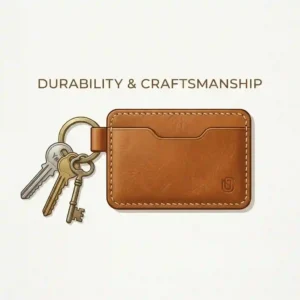
🧩 Problem-Solving Guide: Fixing EDC Frustrations
Even the best products can present challenges in specific edge cases. Over the years, I’ve identified the most common pain points users experience with a leather keychain wallet and how to practically bypass them.
Problem 1: The “Jingle” Won’t Stop
Many people buy a keychain wallet specifically to silence their keys, only to find the external car fob still rattles against the leather.
-
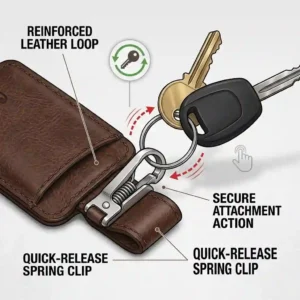
The Solution: Utilize a micro-carabiner or an S-Biner on the exterior loop. By creating a quick-detach system, you can immediately remove the bulky fob when you aren’t driving, slipping just the silent house-key wallet into your pocket.
Problem 2: RFID Inconvenience
If you purchase a fully shielded wallet like the Vaultskin NOTTING HILL, you might be frustrated when your transit pass or office tap-card doesn’t work through the leather.
-
The Solution: The ‘Anti-Recommendation’ Logic applies here. If your daily life requires tapping a card 5 times a day, a fully RFID-blocked wallet is a bad fit for you. Instead, look for a wallet with a dedicated, non-shielded quick-access slot on the exterior, or manually slide the card halfway out of the zipper before tapping.
Problem 3: The Leather Is Tearing at the Hardware
This usually happens with cheap, “genuine leather” models where the split ring connects to the wallet via a thin strip of leather.
-
The Solution: Preventative maintenance. Don’t use your wallet as a handle to pull heavy doors shut. Turn the key by holding the metal key head itself, not by leveraging the leather wallet body.
🔍 How to Choose Your Everyday Carry
When analyzing a leather keychain wallet, you have to look past the surface aesthetic. The difference between a wallet that lasts six months and one that lasts a lifetime lies in the subtle engineering choices. Here is my expert framework for evaluating these items.
1. Evaluate the Leather Grade
Do not be fooled by the phrase “Genuine Leather.” In the industry, this is often a catch-all term for the lowest grade of leather, heavily processed and stamped to look nice. According to authoritative sources like Wikipedia’s comprehensive breakdown of leather types, you should always seek out Full-Grain or Top-Grain leather. Full-grain includes the outermost layer of the hide, providing maximum durability and water resistance. Top-grain is slightly sanded for a uniform look but retains excellent strength.
2. Inspect the Fastening Hardware
A wallet is only as strong as its weakest zipper or snap. If a brand uses YKK zippers or solid brass snaps, they will usually brag about it in the specs. If the hardware is unbranded, it is likely cheap zinc alloy that will chip or derail within a year. Look for solid stainless steel or brass D-rings where the keys attach.
3. Assess Your Actual Capacity Needs
Spread out everything you currently carry. Now, be ruthless. Do you really need those three expired punch cards? The goal of this product is minimization. If you find you still have 10 cards and a wad of cash, a minimalist keychain wallet will just become overstuffed, warping the leather and popping the stitching. Choose a product that comfortably fits your reduced inventory, not your current hoarder-level inventory.
❌ Common Mistakes When Buying Minimalist Wallets
As a consultant, I’ve seen hundreds of dollars wasted because buyers misunderstood the limitations of their gear. Here are the pitfalls you must avoid.
Mistake 1: Ignoring the Car Fob Problem
Modern car fobs are massive. They are essentially small smartphones at this point. Many buyers purchase a sleek, folding key organizer expecting to tuck their fob inside. It won’t fit. You must ensure the wallet has a sturdy, external D-ring specifically designated for attaching your fob.
Mistake 2: Falling for the “Tactical” Hype
The EDC market is flooded with overly aggressive, tactical-looking wallets made of carbon fiber and cheap leather bindings. They look great on Instagram, but in reality, sharp carbon fiber edges aggressively chew through the stitching of your pockets. A smooth, well-burnished leather keychain wallet will slide in and out of your pocket silently without destroying your expensive jeans.
Mistake 3: The “Over-tightening” Trap
For wallets that use a tension screw to hold keys, users often tighten the screw as hard as possible to prevent loosening. This creates extreme friction. When you try to rotate a key out, the leverage snaps the internal post. Always tighten it just enough to provide slight resistance, and rely on thread-locker (as mentioned in the maintenance section) to hold it in place.
⚖️ Traditional Bifolds vs. Keychain Wallets
To truly understand the value proposition, we need a deep comparison of the old guard versus the new wave.
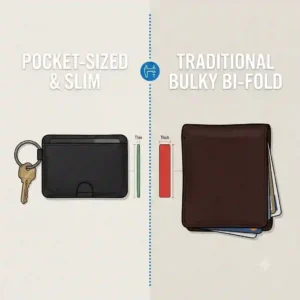
| Feature | Traditional Bifold | Leather Keychain Wallet |
| Pocket Footprint | Large (Often requires back pocket) | Minimal (Easily fits front pocket) |
| Key Management | None (Requires separate keyring) | Integrated (Silences and organizes) |
| Cash Capacity | Excellent (Unfolded bills) | Poor to Moderate (Requires folding) |
| Spinal Health Impact | High (Sciatica from sitting on it) | None (Front pocket carry) |
Looking at this comparison, the health and comfort benefits of migrating to a front-pocket leather keychain wallet are undeniable. Sitting on a thick bifold throws your hips out of alignment—a subtle issue that compounds over years. However, the analysis shows a stark trade-off in cash capacity. If you work in an industry that relies heavily on cash tips or daily physical currency transactions, a keychain wallet will frustrate you, as constantly tri-folding bills to make them fit is incredibly tedious. For the modern, card-first economy, the keychain wallet is vastly superior.
💰 Long-Term Cost & ROI: The “Efficiency Gap”
Let’s talk about the Total Cost of Ownership. It is tempting to buy a $12 PU (polyurethane) leather wallet from a fast-fashion retailer. On paper, it looks exactly like the $50 Bellroy. However, let’s calculate the efficiency gap over a three-year timeline.
A synthetic or cheap “genuine” leather wallet typically experiences edge-fraying and zipper failure around month eight. Over three years, you will likely buy four of them. That is $48 spent, plus the constant frustration of dealing with failing gear, lost keys from broken rings, and cheap aesthetics.
Conversely, investing $50 to $80 in top-tier full-grain leather and stainless hardware means your wallet is just hitting its prime break-in phase at year three. The ROI isn’t just financial; it is cognitive. Knowing your essential items are secure, untangled, and easily deployable saves micro-moments of stress every single day. When assessing long-term cost, always factor in the durability of the moving parts—hardware outlasts leather, but cheap hardware ruins good leather. If a brand offers a multi-year warranty, they are factoring that reliability into the price tag, making it a sound investment.
🚀 What to Expect: Real-World Performance
Before you make a purchase, it is vital to align your expectations with reality. The spec sheet won’t tell you this, but here is what happens when you actually live with these products.
The “Where is my house key?” Phase:
For the first two weeks, muscle memory will betray you. You will reach for your old, jingling keyring, only to remember your keys are now silently tucked inside a leather sleeve. You will likely fumble when trying to fan out the correct key at your front door in the dark. This is normal. By week three, your thumb will automatically know exactly how much pressure to apply to eject the exact key you need without looking.
The Patina Process:
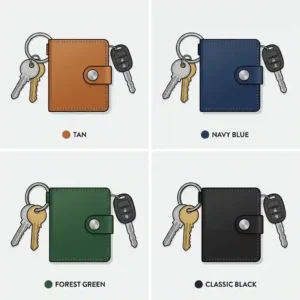
If you buy a lighter-colored leather (like a natural tan or a light brown), expect it to darken significantly. It will absorb indigo dye from your jeans, oils from your fingertips, and ambient moisture. Many users panic and think their wallet is “getting dirty.” In the leather-crafting world, this is a highly desirable transformation. It is the leather telling the story of your daily routine.
Capacity Realities:
If a wallet says it holds “up to 6 cards,” read that as “comfortably holds 4 cards.” Manufacturers test capacity using flat, non-embossed cards without RFID chips. In the real world, raised numbers and thick metal credit cards consume more volume. Always leave a 20% margin of error on capacity claims to ensure you can actually retrieve your cards without needing pliers.
✨ Don’t Miss These Exclusive Deals!
🔍 Ready to silence those keys and ditch the pocket bulge? Take action today! Click on any highlighted item to check current pricing and upgrade your daily routine with a premium leather companion.
🏁 Conclusion: Elevating Your Everyday Carry
Transitioning to a leather keychain wallet is one of the most impactful, low-cost upgrades you can make to your daily routine. By forcing you to audit what you actually need to carry, it removes physical bulk and mental clutter. Whether you opt for the tech-heavy tracking of the Ekster, the bomb-proof simplicity of the Hide & Drink, or the massive utility of the Vaultskin, the key to satisfaction is matching the tool to your exact environment.
Remember, the goal isn’t just aesthetic minimalism; it is functional efficiency. Stop tolerating the noisy, uncomfortable, pocket-destroying keyrings of the past. Invest in quality hardware, treat the leather with respect, and enjoy the streamlined simplicity of a truly optimized everyday carry setup.
❓ FAQs
❓ What is a leather keychain wallet?
✅ A leather keychain wallet is a compact everyday carry accessory combining a cardholder/coin pouch with integrated hardware (like D-rings or internal posts) to hold house keys. It is designed to silence key jingle, organize cards, and reduce overall pocket bulk by consolidating essential items…
❓ Can a leather keychain wallet hold a car fob?
✅ Yes, most modern designs feature an external heavy-duty loop, split ring, or D-ring specifically designed to attach a bulky car fob. However, the fob usually remains external to the wallet body, as internal storage is reserved for flat, traditional keys…
❓ Does a leather keychain wallet block RFID scanners?
✅ It depends on the model. Products like the Vaultskin feature built-in metallic fabric linings that block 13.56 MHz frequencies used by credit cards. Budget or minimalist models often lack this shielding, which is preferred if you frequently tap transit cards…
❓ How many keys can fit in a minimalist keychain wallet?
✅ Most internal post-style or magnetic-closure models comfortably hold between 2 to 6 standard flat mortise or Yale-style keys. Adding more keys usually requires specialized extension posts and may cause the leather to bulge uncomfortably or stretch…
❓ Is full-grain leather better for a keychain wallet?
✅ Absolutely. Full-grain leather retains the dense outermost layer of the animal hide, making it highly resistant to tearing from the internal friction of sharp metal keys. It dramatically outlasts top-grain, genuine, and synthetic PU leathers in heavy daily use…
📚 Recommended for You
- 5 Best Belt Loop Keychain Options for Secure EDC (2026 Expert Review)
- Top 5 Best leather key ring holder Picks for 2026: An Expert’s Guide
- 5 Best unique keychains of 2026: Stop Pocket Bulge Fast
Disclaimer: This article contains affiliate links. As an Amazon Associate, I earn from qualifying purchases. If you purchase products through these links, we may earn a small commission at no additional cost to you.
✨ Found this helpful? Share it with your friends! 💬🤗
[addtoany]
