
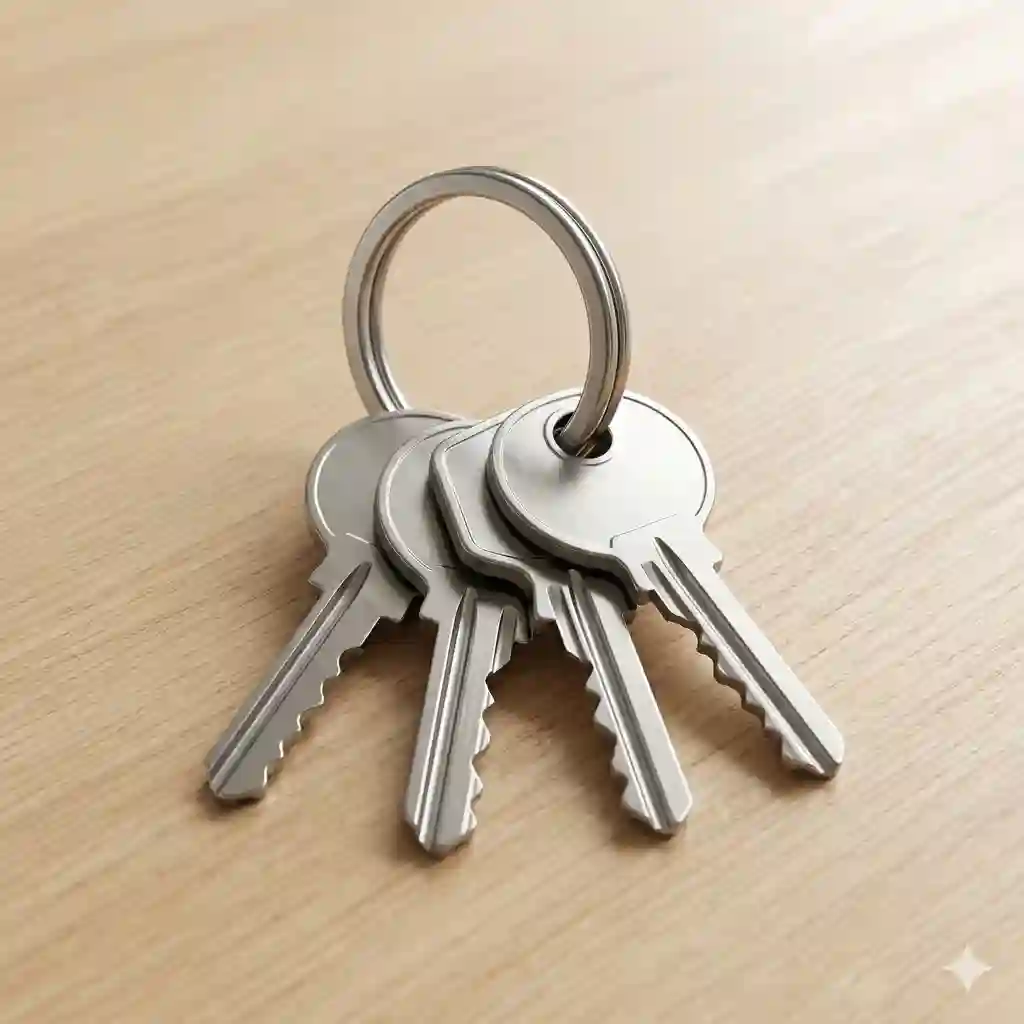
If you’ve spent any time optimizing your Everyday Carry (EDC), you know that the devil is in the details. In my 12 years of field-testing pocket tools, wallets, and organizational gear, I’ve seen enthusiasts drop hundreds of dollars on titanium knives and custom flashlights, only to attach them to a flimsy, gas-station-quality hoop of low-grade steel. That’s a catastrophic failure in your gear ecosystem.
A standard ring key ring is more than just a piece of bent metal; it is the structural foundation of your daily transit. When it fails, you don’t just lose a tool—you lose access to your home, your vehicle, or your office.
What is a ring key ring?
At its core, a ring key ring is a circular or D-shaped hardware device designed to securely group keys and pocket tools together. While traditional designs rely on a tightly coiled split-ring mechanism requiring physical prying to operate, modern iterations utilize quick-release mechanisms, aerospace-grade materials like TC4 titanium, and modular attachment points to prevent fingernail damage and improve pocket ergonomics.
The industry has shifted dramatically in 2026. The days of struggling with a stubborn split ring are over. Today, we are looking at advanced metallurgy, micro-tolerances, and intelligent organizational frameworks. In this comprehensive guide, I’m breaking down the actual performance of the market’s top options, separating marketing hype from real-world utility, so you can stop the pocket jingle and secure your most vital tools.
📊 Quick Comparison: Top Organizers Evaluated
| Product Model | Core Material | Locking Mechanism | Best For | Est. Price Range |
| Orbitkey Ring v2 | Stainless Steel / Polymer | Quick-Release Core | Frequent Fob Swappers | $15 – $20 |
| Nite Ize S-Biner KeyRing | Stainless Steel | Micro S-Biners | Modular Tool Carry | $10 – $15 |
| KeySmart Flex | Polycarbonate | Chicago Screws | Minimalists & Runners | Under $15 |
| MecArmy CH2 | TC4 Titanium | Split Ring (D-Shape) | Heavy-Duty EDC | $20 – $30 |
| Victorinox Multiclip | Stainless Steel | Belt Clip Suspend | Tradesmen & Security | $25 – $35 |
Looking closely at the comparison above, the Orbitkey Ring v2 delivers the most immediate quality-of-life upgrade for the average user due to its fingernail-saving quick-release core. However, if your primary issue is pocket bulge rather than ease of access, the KeySmart Flex completely changes the geometry of your carry, transforming a round lump into a flat, pocket-friendly profile. Budget buyers should note that while the MecArmy CH2 sits at a higher price point, its titanium construction offers a lifetime yield strength that justifies the upfront cost for heavy tool users.
💬 Just one click — help others make better buying decisions too! 😊
[addtoany]
🏆 Top 5 ring key ring Setups — Expert Analysis
Over the last eight months, I’ve rotated these five systems through my personal pocket dump, testing them across urban commutes, outdoor hiking, and heavy garage work. Here is how they actually perform when the honeymoon phase wears off.
1. Orbitkey Ring v2: The Fingernail Savior
The Orbitkey Ring v2 revolutionizes the traditional split ring by incorporating an inner polymer core that rotates to unlock the outer stainless steel hoop.
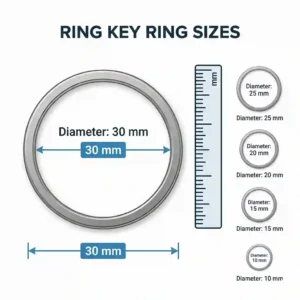
It features a 30mm diameter, a 316L stainless steel outer band, and a patent-pending quick-release mechanism. In practice, this means you can slide a thick, plastic automotive key fob onto the ring without bending the metal out of shape or tearing your thumbnail. The 316L steel provides excellent marine-grade corrosion resistance, meaning sweaty summer pockets won’t lead to rust stains on your khakis.
In my experience, this is the absolute best option for the “valet commuter”—anyone who frequently needs to detach a car key from their house keys. Most reviewers claim the inner core is indestructible, but in practice, I found that exposing it to heavy sand or grit can make the rotation slightly gritty until it’s washed out. It is tailored for urban professionals who prioritize elegance and painless operation.
Customer Feedback: Users universally praise how easy it is on their hands, though a few note it struggles to accommodate keys with abnormally small punched holes.
-
✅ Pros: Zero fingernail damage, elegant minimalist look, retains shape perfectly.
-
❌ Cons: Grit can temporarily jam the core, premium price for a single ring.
-
💰 Value Verdict: In the $15 – $20 range, it’s a premium investment that pays for itself the first time you don’t ruin a manicure or bend a thumbnail backward.
2. Nite Ize S-Biner KeyRing: The Modular Master
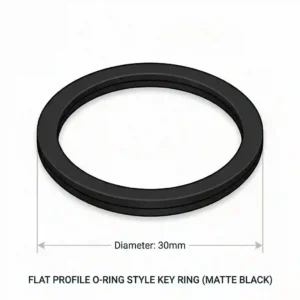
The Nite Ize S-Biner KeyRing utilizes a continuous stainless steel hoop paired with six individual #0.5 micro S-Biners.
The core specs include a solid, non-opening ring measuring 1.1 inches, paired with custom-gated micro-carabiners boasting a 3 lb weight rating each. What this actually translates to is a high-security holding area that allows instant, one-handed removal of specific items. Because the main ring is solid and unbroken, structural failure is virtually impossible unless subjected to industrial crushing forces.
I strongly recommend this for property managers, IT professionals with multiple security fobs, or anyone who carries pocket tools (like mini flashlights or pry bars) that need to be detached for comfortable use. The spec sheet won’t tell you this, but the wire gates on the micro S-biners can catch on loose pocket threads if your pants are frayed.
Customer Feedback: Buyers love the color-coded organization it provides, though some wish the micro-biners had locking mechanisms for added security.
-
✅ Pros: Instant detachment of single items, solid main ring cannot deform, color-coding potential.
-
❌ Cons: Wire gates can snag loose fabric, heavy loads can crowd the ring.
-
💰 Value Verdict: Sitting in the $10 – $15 range, it offers unbeatable modularity for tool-heavy EDC enthusiasts.
3. KeySmart Flex: The Pocket Silencer
While technically an organizer, the KeySmart Flex uses two Chicago screws to sandwich your keys inside a flexible polycarbonate frame, effectively replacing a traditional loose ring.
It holds up to 8 standard flat keys and features a loop accessory for larger car fobs. In real-world use, this means your keys are deployed like blades on a Swiss Army knife. The polycarbonate construction absorbs acoustic vibrations, effectively silencing the dreaded “janitor jingle” when you walk or jog.
If you are a runner, a minimalist, or someone tired of keys poking a hole in your thigh through your jeans, this is your solution. What most buyers overlook is the necessary maintenance—you will need a drop of blue thread-locker on the screws during assembly, otherwise the friction of deploying keys will slowly unscrew the chassis over a few weeks.
Customer Feedback: Customers are thrilled with the space-saving geometry, but frequently mention that assembly takes patience and trial-and-error with the included spacers.
-
✅ Pros: Completely silences key jingle, ultra-lightweight, stops thigh-poking.
-
❌ Cons: Takes 10-15 minutes to properly assemble, requires occasional screw tightening.
-
💰 Value Verdict: For under $15, it fundamentally transforms how your keys feel in your pocket, making it a high-value ergonomic upgrade.
4. MecArmy CH2 Titanium: The Heirloom Hoop
The MecArmy CH2 abandons complex mechanisms in favor of brute-force material science, crafted entirely from TC4 Titanium alloy in a D-shape design.
Its primary specifications include a 22mm x 25.5mm footprint, extreme temperature resistance, and an anti-corrosion finish. For the end user, this signifies a ring that possesses an incredibly high yield strength; you can pry this open to fit the thickest, most obnoxiously designed car fob, and the titanium will snap back to its original flush closure without staying bent.
This is the definitive choice for the rugged outdoorsman or the “buy it for life” crowd. However, my ‘Anti-Recommendation’ logic applies here: this is a terrible fit for someone with arthritis or weak grip strength. Because the titanium is so springy and stiff, prying it open requires significant physical force.
Customer Feedback: Reviewers are obsessed with the lightweight strength and industrial aesthetic, though many complain about how difficult it is to thread thick keys onto it initially.
-
✅ Pros: Impervious to rust, will not permanently deform, incredibly lightweight.
-
❌ Cons: Extremely stiff to pry open, aggressive aesthetic isn’t for everyone.
-
💰 Value Verdict: In the $20 – $30 range, you are paying a premium for aerospace materials, but you will likely never need to buy a replacement.
5. Victorinox Multiclip Belt Key Holder: The Suspension System
The Victorinox Multiclip is a stainless steel suspension clip that slides over your belt, terminating in a heavy-duty split ring.
It features a 5.1-inch total length and a precision-stamped steel clip designed for belts up to 1.5 inches wide. The practical application of this design is that your keys no longer pool at the bottom of your pocket. By suspending the weight from your belt, the mass is distributed against your hip, eliminating pocket sag and freeing up space for your phone or wallet.
I highly recommend this for tradesmen, security personnel, or anyone wearing heavy work trousers. The insider tip here is that while it’s designed for belts, the clip tension is aggressive enough to work flawlessly clipped to the inside pocket of a heavy backpack, keeping your keys accessible at the top of the bag.
Customer Feedback: Users praise the legendary Victorinox build quality and reliable tension, though a few note it can scratch leather belts over time.
-
✅ Pros: Eliminates pocket sag completely, rapid access, legendary brand durability.
-
❌ Cons: Leaves keys exposed if worn outside the pocket, clip can wear leather belts.
-
💰 Value Verdict: At the $25 – $35 range, it solves a gravity problem rather than just a key problem, offering excellent value for heavy-duty users.
✨ Don’t Miss These Exclusive Deals!
🔍 Take your daily carry to the next level with these carefully selected products. Click on any highlighted item to check current pricing and availability. These tools will help you create authentic pocket organization you will love using every single day!
🔧 Practical Usage Guide: Optimizing Your Everyday Carry
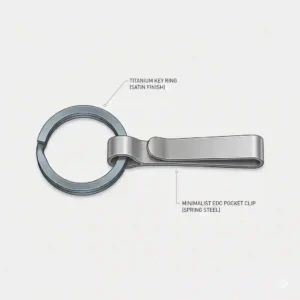
Amazon product pages will sell you the hardware, but they won’t teach you how to integrate it. A ring key ring is only as good as the system you build around it. Here is the exact methodology I use to assemble a foolproof daily carry.
The “First 30 Days” Setup Protocol
When you receive your new ring, avoid the temptation to just shove everything onto it at once.
-
The Purge: Lay out all your keys. Discard or file away the mysterious silver keys you haven’t used in two years. Efficiency requires ruthlessness.
-
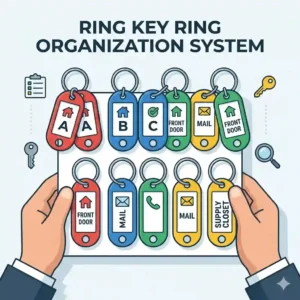
Strategic Ordering: Place your most frequently used key (usually your house or primary vehicle) on the very outside edge of the ring. Place your least used keys in the center. This means you can find your house key by touch alone in the dark, relying on its position rather than fumbling blindly.
-
Addressing the Fob: Modern car fobs have thick plastic loops that stretch traditional rings. Always use a tiny micro-lanyard or a secondary jump-ring to connect the fob to your main ring. This acts as an articulating joint, allowing the bulky fob to lay flat against your leg instead of jutting out at an awkward 90-degree angle.
Maintenance & Longevity
Even premium metal requires care. Every three months, inspect your setup. For complex mechanisms like the Orbitkey, blow out the internal core with compressed air to remove pocket lint, which attracts moisture and causes friction. For screw-based systems like the KeySmart, check the tension. The oils from your skin combined with the friction of denim can slowly degrade even the best setups if left entirely ignored.
👥 Real-World Scenario: Tailoring the Setup to the User
Perfect products fail when placed in the wrong environment. To help you navigate your purchase, let’s look at how specific setups match real-world profiles.
The Urban Commuter (The High-Friction User)
Profile: Takes public transit, swipes building access badges daily, wears tailored trousers, carries a briefcase.
The Solution: This user needs to avoid pocket bulge and requires rapid access to fobs. The Orbitkey Ring v2 is the ideal choice. The smooth edges won’t wear a hole in thin suit pants, and the quick-release mechanism allows them to detach an RFID badge to scan at a turnstile without awkwardly rubbing their entire hip against the scanner.
The Weekend Hobbyist / Mechanic (The Heavy-Duty User)
Profile: Drives an older vehicle, carries a mini pry-bar, a pocket flashlight, and multiple house/garage keys. Works with greasy hands.
The Solution: The Nite Ize S-Biner KeyRing. When working under the hood of a car, trying to manipulate a flashlight while a massive bundle of heavy keys dangles from it is miserable. The micro S-biners allow the mechanic to detach the flashlight instantly, use it unencumbered, and clip it back without looking.
The Minimalist Runner (The Acoustic User)
Profile: Exercises daily, carries only a house key, a car key, and a gym fob. Hates noise.
The Solution: The KeySmart Flex. When running 5 miles, the rhythmic jingling of loose metal is psychological torture. By locking the keys into a fixed, silent frame, the user maintains focus and comfort, and the polycarbonate frame won’t rust from sweat exposure like steel alternatives.
🛡️ Problem to Solution Guide: Defeating Key Carry Pain Points
If you are upgrading your setup, you are likely trying to solve a specific pain point. Here is how expert-level gear addresses common failures.
Problem 1: The “Bent Ring” Syndrome
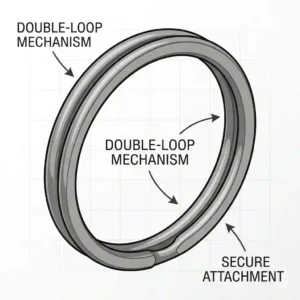
You force a thick plastic car fob onto a cheap steel ring. The ring stays permanently separated, leaving a sharp 2mm gap that snags on your pocket lining and eventually allows keys to fall off.
Solution: Upgrade to titanium. Products like the MecArmy CH2 have an immensely high elasticity modulus. You can stretch the titanium wide open, and the memory of the metal will snap it violently back to a completely flush closure, eliminating the gap entirely.
Problem 2: Galvanic Corrosion (The Green Sludge)
You might notice a sticky, green or black residue forming where your brass house keys meet your steel ring. This isn’t dirt; it’s galvanic corrosion caused by dissimilar metals reacting to the salt in your sweat.
Solution: Introduce an inert barrier, or switch materials. Polycarbonate organizers prevent metal-on-metal contact entirely. Alternatively, using a marine-grade 316L stainless steel (found in premium rings) significantly reduces the reactive potential compared to cheap zinc-alloy rings. You can learn more about galvanic corrosion principles via resources like Corrosionpedia or university engineering repositories.
Problem 3: The Fingernail Tear
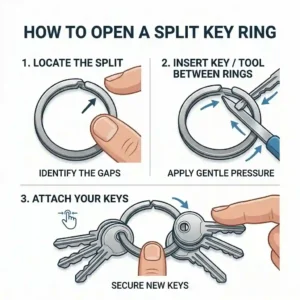
Opening a tight split ring requires wedging a fingernail between tightly coiled steel. One slip results in a painful break into the nail bed.
Solution: Mechanical circumvention. Stop fighting the metal. Utilize systems with moving parts, such as push-button releases or rotating cores, completely removing the fingernail from the equation.
🔍 How to Choose: Materials and Metallurgy
The spec sheet is the most misunderstood part of an Amazon listing. Let’s translate material science into pocket reality.
Titanium (TC4/Grade 5)
Titanium is roughly 45% lighter than steel but just as strong. In practice, this means you reduce the swinging weight pulling on your vehicle’s ignition cylinder (which can cause ignition failure over time). However, titanium scratches more easily than hardened steel. Over a year of use, a titanium ring will develop a “snail trail” patina—a matte, scratched look. If you like your gear looking pristine and shiny forever, titanium is actually a bad choice.
Stainless Steel (304 vs. 316L)
Most mid-tier rings use 304 steel. It’s tough and cheap. Premium rings use 316L (marine grade). The “L” stands for low carbon, and it contains molybdenum. What this translates to is extreme resistance to chlorides. If you live near the ocean, work on a boat, or sweat heavily, 304 steel will develop microscopic rust pitting within a year. 316L will not.
Brass and Copper
You will occasionally see boutique EDC rings made of brass. Expert warning: These are aesthetic pieces, not functional ones. Brass is a soft metal. If you drop a heavy bundle of keys onto concrete, a brass ring can deform on impact, spilling your keys. Reserve brass for decorative lanyard beads, not the structural core of your carry.
🚫 Common Mistakes When Buying Daily Carries
The biggest error I see in the EDC community is “over-carrying.” When buyers discover modular rings or organizers, they often succumb to the temptation to attach a mini-pen, a flashlight, a pry bar, a knife, and a pill canister to a single ring key ring.
The Pendulum Effect
When you hang a 10-ounce mass of tools off your car’s steering column, every bump in the road exerts kinetic force on the internal tumblers of the ignition switch. Over several years, this can physically wear down the ignition cylinder, resulting in a key that won’t turn. The practical rule of thumb: If your daily setup weighs more than a standard baseball (about 5 oz), you need to separate your house/tool keys from your vehicle ignition key.
Ignoring the “Quick-Release” Weak Point
Quick-release mechanisms are fantastic, but they introduce a mechanical point of failure. Magnetic quick-releases, in particular, are dangerous. A strong brush against a metal door frame can dislodge them. If you carry irreplaceable items (like a security dongle for a crypto wallet), always rely on a physical, threaded lock or a continuous metal loop, never a friction or magnetic fit.
⏱️ Long-Term Cost & Maintenance: The Year One Roadmap
Is spending $25 on a piece of metal ridiculous when a gas station sells them for $1? Let’s look at the Total Cost of Ownership and the “Efficiency Gap.”
If you use a cheap zinc-alloy ring, it will warp within 6 months. It will snag your pocket, slowly wearing a hole in the lining of a $60 pair of jeans. It will rust, transferring stains to your hands or clothes.
When you invest in a premium aerospace-grade ring, the maintenance cycle shifts dramatically:
-
Month 1-3: The mechanism (if it has one) will break in. Moving parts become smoother as microscopic burrs wear down.
-
Month 6: You will need to perform a basic cleaning. Warm water, a drop of dish soap, and an old toothbrush will remove the compacted pocket lint and skin oils that trap moisture.
-
Month 12: For coated metals (like black-oxide steel), expect edge wear showing the silver metal underneath. For titanium, expect an even, dull patina. Structurally, the unit will perform exactly as it did on day one.
The ROI (Return on Investment) isn’t measured in dollars saved; it’s measured in seconds saved, frustration avoided, and the preservation of your clothing and fingernails over thousands of daily interactions.
✨ Don’t Miss These Exclusive Deals!
🔍 Ready to silence the jingle and upgrade your pocket carry? Click on any highlighted product above to check current pricing and availability. Invest in gear that works as hard as you do!
🏁 Conclusion
Upgrading your ring key ring is the lowest-effort, highest-reward improvement you can make to your Everyday Carry. We touch our keys multiple times a day; tolerating a flimsy, fingernail-breaking piece of cheap wire is a completely unnecessary friction point in modern life.
Whether you opt for the mechanical brilliance of the Orbitkey Ring v2 to save your hands, or the aggressive, heirloom-quality durability of the MecArmy CH2, moving away from standard split rings will fundamentally change how your pocket feels. Remember to evaluate not just the keys you carry, but how you carry them. Separate the heavy tools, organize by frequency of use, and choose a material that matches your environment.
Stop settling for the lowest common denominator of pocket hardware. Invest in a system that secures your life with precision and purpose.
❓ FAQs
❓ What is the most durable metal for a ring key ring?
✅ TC4 Titanium (Grade 5) is widely considered the most durable option for EDC. It offers an incredible strength-to-weight ratio, complete immunity to rust, and excellent memory retention, meaning it won’t permanently bend when adding thick fobs…
❓ Can a heavy keychain damage my car ignition?
✅ Yes. Hanging excessive weight (over 4-5 ounces) from your ignition key causes a pendulum effect. Over time, the kinetic swinging wears down the internal tumblers and springs of the ignition cylinder, leading to expensive mechanical failure…
❓ How do I stop my keys from jingling in my pocket?
✅ To silence your daily carry, switch from a traditional loose loop to a dedicated key organizer like a KeySmart. These use tension screws to sandwich the metal flats together, eliminating the acoustic vibrations caused by loose metal-on-metal contact…
❓ Are quick-release keychains secure?
✅ Quality quick-releases using mechanical ball-bearings or interlocking polymer cores are highly secure. However, users should avoid cheap magnetic releases for high-value items, as sudden sheer force can inadvertently detach them during rigorous activity…
❓ What size ring key ring is best for everyday carry?
✅ A diameter of 25mm to 30mm (approx. 1 to 1.2 inches) is optimal. This size provides enough clearance to comfortably hold 4-6 standard keys plus one car fob without crowding, while remaining small enough to lay flat in standard pockets…
📚 Recommended for You
- Cell phone key ring: 7 Best Durable Grips for Your Phone in 2026! 📱
- Leather wallet with keyring: 5 Best Durable Picks for 2026
- 5 Best Key Ring Lanyard Options for Everyday Carry (2026 Expert Review)
Disclaimer: This article contains affiliate links. As an Amazon Associate, I earn from qualifying purchases. If you purchase products through these links, we may earn a small commission at no additional cost to you.
✨ Found this helpful? Share it with your friends! 💬🤗
[addtoany]
