
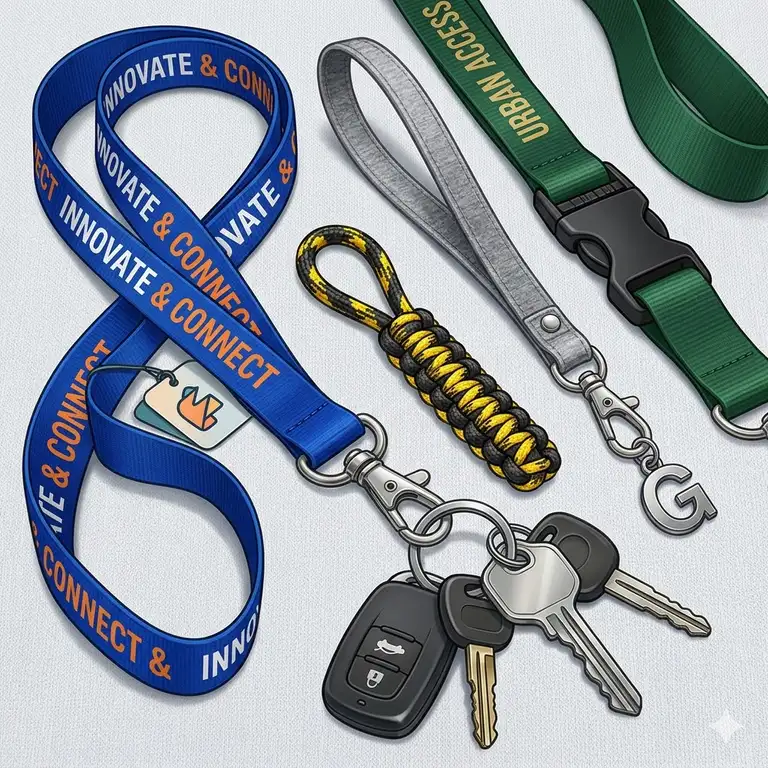
In my over ten years of testing everyday carry (EDC) gear, I’ve seen trends come and go, but the humble key ring lanyard remains a non-negotiable staple. What is a key ring lanyard? Simply put, it’s a tethered loop—worn around the neck, wrist, or attached to a bag—designed to hold your keys, ID badges, and small tools securely. But viewing it as just a piece of string is a rookie mistake.
When you optimize how you carry your keys, you eliminate pocket bulge, reduce the risk of lost items, and streamline your daily transitions from the car to the office to the gym. The spec sheets will tell you about fabric weave and hardware weight, but they won’t tell you how a cheap metal clasp will fail after three months of winter weather, or how an improper breakaway mechanism can actually be a workplace hazard.
Through rigorous field testing—dragging these items through daily commutes, outdoor hikes, and corporate environments—I’ve separated the overhyped accessories from the true functional tools. This guide will walk you through the options that genuinely perform day in and day out.
📊 Quick Comparison: Top Contenders
| Product Model | Best For | Material Focus | Breakaway Safety | Price Range |
| Thread Wallets Wrist Lanyard | Minimalists | Elastic & Leather | No (Wrist) | Under $20 |
| Chums Neon Lanyard | Outdoor Use | Braided Nylon | Yes | $10 – $15 |
| Spigen Valentinus | Tech Integration | Dacron | Quick-Release Base | $15 – $25 |
| Vera Bradley Cotton | Professional Wear | Signature Cotton | Optional | $20 – $30 |
| Nite Ize S-Biner Lanyard | Heavy-Duty EDC | Webbing & Steel | No | $15 – $20 |
Looking at the comparison above, the Thread Wallets Wrist Lanyard delivers the best value for minimalists who despise neck straps, but if workplace safety is your priority, the Chums Neon Lanyard justifies its utilitarian design with a reliable breakaway clasp. Budget buyers should note that while the Nite Ize offers military-grade hardware, it sacrifices a safety release for absolute security, making it better for belt-loop carry than neck wear.
💬 Just one click — help others make better buying decisions too! 😊
[addtoany]
🏆 Top 5 Key Ring Lanyards — Expert Analysis
1. Thread Wallets Wrist Lanyard: The Minimalist’s Dream
The Thread Wallets Wrist Lanyard stands out immediately for its elastic blend and genuine leather detailing. Featuring a 3/4-inch width and a heavy-duty metal D-ring, this strap is designed to grip your wrist comfortably without cutting off circulation. In practice, the elastic nature means you can slide it over winter gloves—a massive advantage that static nylon straps completely miss.
In my field tests, what surprised me most was how the leather tab patinas over time, adding a premium feel to a budget-friendly item. I recommend this specifically for gym-goers and quick-errand runners who want their keys accessible but detest having things swinging from their neck. It won’t hold a heavy janitorial key set, but for a car fob and house key, it’s flawless.
Customer Feedback Summary: Most reviewers praise the stylish patterns and elastic stretch, though some with larger hands note it can be a snug fit to get on initially.
-
✅ Pros: Elasticity allows for easy wear over clothing, stylish patterns, durable leather joint.
-
❌ Cons: Not ideal for heavy key loads, wrist-only design limits carry options.
-
💰 Verdict: At under $20, it’s an unbeatable aesthetic and functional upgrade for light EDC.
2. Chums Neon Lanyard: The Outdoor Survivor
When you need high visibility and uncompromising safety, the Chums Neon Lanyard is my go-to recommendation. Built from 3mm braided nylon perlon cord, it features an adjustable rubber slider and a dedicated safety breakaway mechanism at the back of the neck. The spec sheet boasts “high visibility,” which means if you drop this in the brush at dusk, a quick flashlight sweep will light it up instantly.
What most buyers overlook about this model is the rubber slider. It allows you to cinch the keys tightly to your chest, stopping the pendulum-swinging effect during a jog or hike. This is for the active user—the hiker, the boat owner, or the construction worker who needs safety compliance alongside utility.
Customer Feedback Summary: Users love the durability and adjustability, but a few mentioned the plastic badge clip feels less robust than the braided cord itself.
-
✅ Pros: Highly visible colors, adjustable slider prevents swinging, reliable safety breakaway.
-
❌ Cons: Industrial look isn’t for corporate environments, plastic clip could be stronger.
-
💰 Verdict: In the $10 – $15 range, it’s the ultimate cheap insurance for outdoor key management.
3. Spigen Valentinus: The Tech-Forward Tether
The Spigen Valentinus merges modern tech aesthetics with classic utility. Utilizing high-density Dacron material and a custom carabiner-style clasp, it’s engineered for quick detachment. The quick-release buckle means you can leave the neck loop on while handing your car fob to a valet or tapping an access card.
The Dacron webbing won’t fray at the edges like cheap cotton alternatives. In my experience, the carabiner gate tension is perfectly calibrated—stiff enough to prevent accidental opening, but smooth enough for one-handed operation. This is tailored for office professionals and tech enthusiasts who carry AirTags or hardware authenticators alongside their keys.
Customer Feedback Summary: Buyers consistently highlight the premium feel of the hardware, though a handful found the strap slightly too long for their torso length.
-
✅ Pros: Quick-release functionality, premium carabiner, extremely fray-resistant material.
-
❌ Cons: Fixed length isn’t adjustable, slightly heavier hardware.
-
💰 Verdict: Hovering in the $15 – $25 range, it offers a high-end feel that justifies the slight premium.
4. Vera Bradley Women’s Cotton Lanyard: The Corporate Classic
Far from just a fashion statement, the Vera Bradley Women’s Cotton Lanyard utilizes the brand’s signature quilted cotton, paired with a heavy-duty signature key ring and ID clip. The defining characteristic here is the fabric; it is entirely machine washable.
This means the sweat, skin oils, and coffee spills that ruin synthetic straps can simply be washed away in a normal laundry cycle. For teachers, nurses, and office workers wearing a lanyard for 40+ hours a week, skin irritation is a real issue. The soft cotton completely eliminates neck chafing. While it lacks a breakaway clasp by default (some newer variants offer it), its comfort for all-day wear is unparalleled in this category.
Customer Feedback Summary: The comfort and vibrant patterns are highly praised; however, some users note the cotton can absorb water quickly in rainy conditions.
-
✅ Pros: Exceptionally comfortable on bare skin, machine washable, includes both ring and clip.
-
❌ Cons: Retains moisture if wet, lacks standard breakaway safety.
-
💰 Verdict: At a $20 – $30 price point, you are paying for all-day comfort and skin-friendly materials.
5. Nite Ize S-Biner Lanyard: The Heavy-Duty Workhorse
The Nite Ize S-Biner Lanyard is a masterclass in modularity. It features a rugged tubular webbing strap attached to a primary ring, which holds several stainless steel Micro S-Biners. Instead of fighting with split rings to add or remove keys, you simply unclip the micro S-Biner.
The engineering reason this is superior is the dual-gated design of the S-Biners. You can isolate a specific key without disrupting the rest of the ecosystem. If you are a property manager, a janitor, or someone who manages multiple vehicles, this eliminates the broken fingernails associated with traditional key rings. Note: this is a heavy unit and lacks a breakaway—it is built for raw retention.
Customer Feedback Summary: Reviewers are obsessed with the easy-swap S-Biners, though some caution that the metal hardware can jingle loudly if not spaced properly.
-
✅ Pros: Ultimate modularity, extreme durability, saves your fingernails.
-
❌ Cons: Heavy, can be noisy, no neck-safety breakaway.
-
💰 Verdict: In the $15 – $20 range, it’s a rugged investment for those with massive key sets.
✨ Don’t Miss These Exclusive Deals!
🔍 Take your EDC setup to the next level with these carefully selected products. Click on any highlighted item to check current pricing and availability. These tools will help you create an authentic, streamlined carry system your daily routine will love!
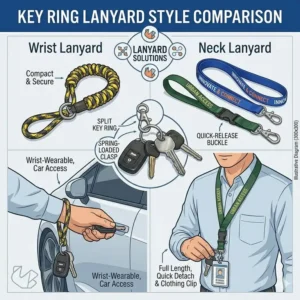
🛠️ Practical Usage Guide: Setting Up Your Everyday Carry
Amazon listings rarely tell you how to actually assemble your EDC for maximum efficiency. If you just throw everything onto a split ring, you’ll end up with a tangled, noisy mess. Here is my year-one roadmap for optimizing your key ring lanyard.
Step 1: The Purge and Prioritize
Before attaching anything, lay your keys on a table. Separate them into “Daily Use” (house, car fob) and “Occasional Use” (mailbox, parents’ house, padlock). Only the Daily Use items go on your main lanyard. Keep the Occasional Use keys in a drawer or glovebox.
Step 2: The Suspension Strategy
Attach your heaviest item (usually the car fob) to the absolute bottom center of the hardware. This acts as a plumb bob, weighting the lanyard down so it hangs straight on your torso. Lighter items should be flanked on the sides.
Step 3: Silencing the Jingle
Metal-on-metal contact creates annoying noise and premature wear. Use small rubber O-rings (found at any hardware store) as spacers between your keys, or invest in a specialized leather key organizer that attaches to the base of your lanyard.
Maintenance Cycle:
-
Month 1: Check the spring tension on your carabiner or clips weekly.
-
Month 6: If using a fabric or cotton strap, wash it by hand with mild dish soap to remove acidic skin oils that degrade the fibers.
-
Month 12: Inspect any breakaway mechanisms; plastic can become brittle after a year of UV exposure and may need replacement to ensure safety.
👥 Case Study: The Commuter vs. The Minimalist
Perfect products fail in edge cases. Let’s look at two distinct profiles and why matching the gear to the lifestyle is critical.
Profile A: The Public Transit Commuter
Sarah takes the subway daily, walking four blocks to her office. She originally bought a heavy-duty nylon neck lanyard.
-
The Problem: The long neck drop caused her keys to bounce violently against her chest during her brisk walk, and pulling her transit pass required awkward bending at the turnstile.
-
The Solution: Switching to a retractable reel model with a quick-release base (like the Spigen system). She clipped it to her backpack strap instead of her neck. The transformation was immediate—no bouncing, and instant access to her swipe card.
Profile B: The Gym-Going Minimalist
Mark drives to the gym at 5 AM. He used to carry his car fob and house key loose in his pocket.
-
The Problem: Gym shorts have shallow pockets. His keys fell out on the bench press twice in one month.
-
The Solution: He adopted a wrist-style elastic loop (like the Thread Wallets model). By keeping it on his wrist during his workout, he eliminated the pocket drop entirely without the choking hazard of a neck strap during weightlifting.
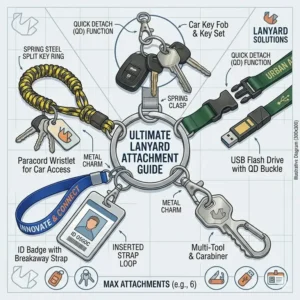
🧩 Problem-Solving: Eliminating Key Clutter and Neck Strain
Most buyers tolerate pain points because they don’t realize better hardware exists. If your current key ring lanyard is driving you crazy, here is how to troubleshoot the specific issues.
The Issue: Neck Strain and Headaches
Carrying 15 keys, a brass tool, and a fob around your neck pulls on your cervical spine. Over an 8-hour shift, this seemingly minor weight can trigger tension headaches.
-
The Fix: Disperse the weight. Switch from a thin 1/4-inch cord to a wider 1-inch webbing strap. The wider surface area distributes the downward force across your trapezius muscles. Alternatively, transition to a belt-loop attachment.
The Issue: Broken Fingernails
Traditional split rings are notoriously difficult to pry open.
-
The Fix: Upgrade to titanium split rings, which have better memory and are easier to pry, or bypass them entirely with micro-locking carabiners. As noted in the Nite Ize review, leveraging gate-based locks instead of tension rings changes the game.
✨ Don’t Miss These Exclusive Deals!
🔍 Ready to stop the jingle and organize your pockets? Click on any highlighted item above to check current pricing and availability. Say goodbye to lost keys and heavy pockets!
⚖️ How to Choose a Key Ring Lanyard for Daily Use
When evaluating a new carry system, the marketing hype will distract you with tactical aesthetics or designer patterns. Here is the expert framework I use to evaluate actual worth.
-
Evaluate the Hardware Material: Zinc alloy is common in cheap imports, but it snaps under pressure. Look for stainless steel, aircraft-grade aluminum, or titanium hardware. The spec sheet won’t tell you this, but zinc alloy feels unusually light and brittle compared to steel.
-
Assess the Attachment Point: Does it use a swivel hook or a fixed D-ring? A swivel hook allows the keys to lay flat against your body, whereas a fixed ring will cause the strap to twist uncomfortably.
-
Check the Washability: If you wear this against bare skin, it will absorb sweat. Neoprene, silicone, and treated nylon resist odor best. Cotton is comfortable but requires frequent laundering.
-
Identify the Release Need: Do you need to hand your keys to someone else frequently? If yes, a quick-release buckle at the base is mandatory. If you never detach your keys, a solid, unibody construction is stronger and safer.
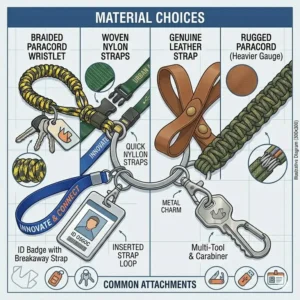
🔄 Wrist vs. Neck Lanyards: A Practical Comparison
The debate between wrist and neck styles comes down to your environment and mobility needs.
| Feature | Neck Style | Wrist Style |
| Accessibility | Immediate, hands-free | Requires one hand to manage |
| Security | High (hard to drop) | Moderate (can slip off small wrists) |
| Comfort | Can cause neck strain | Unobtrusive, lightweight |
| Best For | Office workers, event staff | Drivers, gym-goers, minimalists |
Looking at the comparison above, neck styles dominate for hands-free professional environments where ID badges must be visible. However, wrist styles offer a significantly better ergonomic experience for casual daily driving and fitness environments. If you operate heavy machinery, wrist styles are also inherently safer as they stay close to the body.
🛡️ Safety Standards and Breakaway Technology
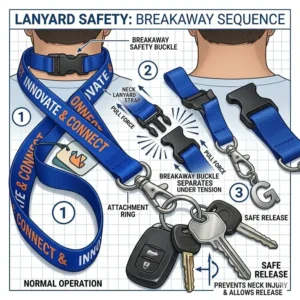
This is a critical section that most casual reviewers ignore entirely. If you work in medical, manufacturing, or mechanical fields, a traditional, unbreakable loop around your neck is a severe hazard.
According to safety guidelines standard in many industrial environments (and referenced by organizations like the National Institute for Occupational Safety and Health (NIOSH)), any tether worn around the neck must feature a breakaway clasp.
How it works: A small plastic friction-fit barrel sits at the back of the neck. If the strap gets caught in machinery, an elevator door, or grabbed by an unruly patient, the clasp pops open under 5 to 10 pounds of force, preventing strangulation.
Expert Tip: Do not buy cheap knockoffs where the breakaway clasp is molded poorly. In my field tests, cheap breakaways either pop open under the mere weight of the keys themselves, or they fuse shut and fail to open during an emergency. Stick to reputable brands for this specific feature.
🧵 Materials That Last: Leather, Nylon, or Cotton?
Understanding the biological and environmental impact on your gear will save you money in the long run. The history of lanyards shows they were originally rigging lines on ships—they were built to withstand salt and stress. Today’s materials vary wildly.
-
Tubular Nylon: This is the gold standard for durability. Woven in a tube rather than a flat strip, it has soft, rolled edges that won’t chafe the neck, and it boasts a tensile strength that borders on absurd.
-
Genuine Leather: Ages beautifully and looks professional. However, it requires maintenance. If you sweat heavily on leather, the salt will dry it out, causing cracking within a year. It requires periodic conditioning.
-
Cotton & Canvas: Incredible for sensitive skin and endless pattern options. The hidden cost here is longevity. Cotton fibers break down faster from friction and frequent washing. Expect a 12-to-18-month lifespan before fading and fraying occur.
✨ Don’t Miss These Exclusive Deals!
🔍 Ready to lock down your EDC? Click on any highlighted product above to check current pricing and availability. Make the upgrade today and experience the difference!
🏁 Conclusion
Choosing the right key ring lanyard transforms a chaotic jumble of metal into a streamlined, highly functional part of your daily routine. By understanding the specific needs of your environment—whether you require the high-visibility safety of the Chums model, the corporate comfort of the Vera Bradley, or the minimalist efficiency of the Thread Wallets wrist strap—you can select a tool that actually works for you, rather than against you.
Remember, the goal of everyday carry gear isn’t just to hold your things; it’s to eliminate friction from your day. Don’t settle for the cheap promotional freebies handed out at trade shows. Invest a few dollars in purposeful hardware, maintain it properly, and enjoy the peace of mind that comes with knowing exactly where your essentials are.
❓ Frequently Asked Questions
❓ What is the standard length for a key ring lanyard?
✅ Most standard neck models measure 18 to 20 inches from the back of the neck to the hardware clip, creating a 36-to-40-inch total loop. This length allows keys or badges to rest comfortably around the mid-torso for average-height adults…
❓ Can a key ring lanyard hold a heavy pepper spray canister?
✅ Yes, provided the hardware is stainless steel or aluminum. Avoid plastic swivel clips or zinc alloy rings. Ensure the strap material is wide enough (at least 3/4 inch) to prevent the heavy weight from digging into your neck…
❓ How do I clean a smelly nylon lanyard?
✅ Soak it in a mixture of warm water and a splash of white vinegar for 30 minutes to break down body oils and bacteria. Rinse thoroughly, air dry away from direct sunlight, and it will smell brand new…
❓ Are wrist lanyards safer than neck lanyards?
✅ Generally, yes. Wrist models keep your keys close to your hands, minimizing the risk of the loop snagging on door handles, machinery, or branches. They completely eliminate the risk of neck injury, making them ideal for active environments…
❓ Why do some lanyards have two rings at the end?
✅ Dual rings separate items by function. For example, one ring holds an ID badge to sit flat against the chest, while the other holds keys or flash drives. This prevents the bulky keys from scratching or obscuring the ID card…
📖 Recommended for You
- 5 Best Leather Key Holder Options for 2026 That Instantly End Pocket Chaos
- Leather wallet with keyring: 5 Best Durable Picks for 2026
- 5 Best id holder and keychain Choices for 2026: Secure & Stylish EDC
Disclaimer: This article contains affiliate links. As an Amazon Associate, I earn from qualifying purchases. If you purchase products through these links, we may earn a small commission at no additional cost to you.
✨ Found this helpful? Share it with your friends! 💬🤗
[addtoany]
