
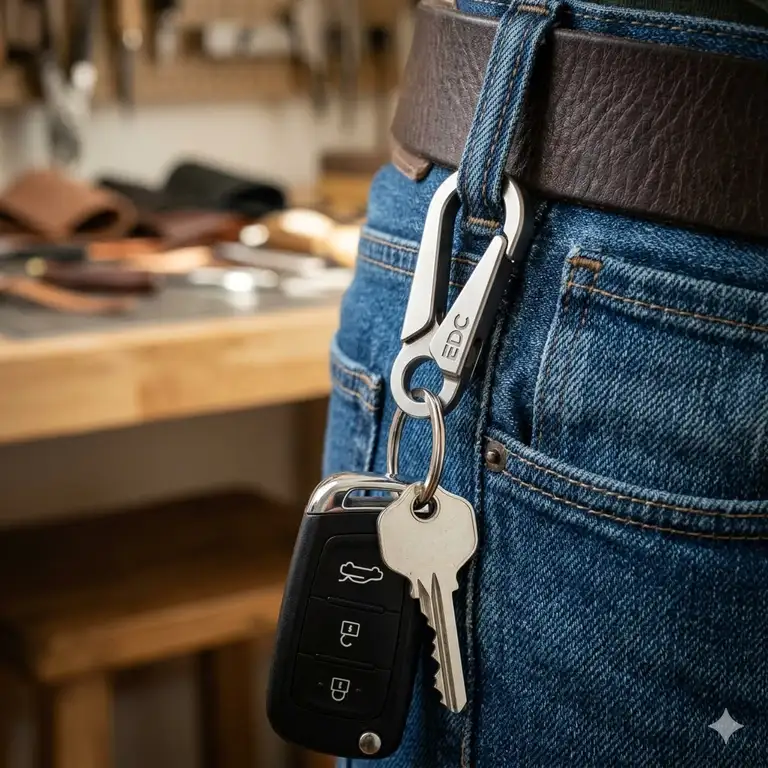
In my decade of consulting on everyday carry (EDC) systems, I’ve realized that the humble key clip is the most undervalued piece of hardware in a person’s pockets. A key clip is a mechanical fastening device—typically a carabiner, suspension clip, or specialized hook—designed to secure your keys to a fixed point like a belt loop, bag strap, or the rim of a pocket. Its primary function is to prevent “key migration,” that annoying phenomenon where your keys sink to the bottom of your pocket, creating a jagged, uncomfortable lump that eventually eats holes through your clothes.
In 2026, the market has moved far beyond the flimsy “gas station carabiner.” Modern designs utilize Grade 5 titanium, magnetic quick-releases, and dual-gate security to ensure your most important assets stay exactly where you put them. What most people overlook is that a proper clip isn’t just about storage; it’s about accessibility. When you’re juggling groceries or trying to unlock your front door in the rain, being able to find your keys by muscle memory alone is a game-changer. I’ve field-tested hundreds of these, and the difference between a high-quality stainless steel spring and a cheap alloy gate is something you feel every single time you press it.
The ergonomics of a key clip matter more than the spec sheet suggests. A clip that is too stiff will discourage you from using it, while one that is too loose risks a “silent drop”—where your keys slip off without a sound. In this guide, we’re going to dive deep into the mechanical nuances of the best clips available today, ensuring your carry is both secure and effortless.
Quick Comparison: Top 2026 Key Clips
| Product Name | Primary Material | Best For | Security Level | Price Range |
| Orbitkey Clip v2 | Zinc Alloy / Stainless | Professional Carry | High (Magnetic) | Around $40 |
| Nite Ize S-Biner | Stainless Steel | Versatility | Very High (Locking) | $5 – $15 range |
| KeySmart Nano Clip | Stainless Steel | Deep Pocket Carry | Medium | Under $15 |
| The James Brand Mehlville | Grade 4 Titanium | Aesthetics & Durability | High (Dual Gate) | $60 – $80 range |
| Trayvax Keyton | Leather / Stainless | Belt Loop Security | High | Around $30 |
Expert Analysis: Looking at the data above, the Orbitkey Clip v2 offers the best balance for office workers who need quick magnetic access, whereas the Nite Ize S-Biner remains the king of raw utility for those on a budget. If you are someone who prioritizes weight-to-strength ratios, the titanium construction of The James Brand Mehlville justifies its higher price point by offering a lifetime of corrosion resistance that cheaper alloys simply cannot match.
💬 Just one click — help others make better buying decisions too!😊
[addtoany]
Top 5 Key Clips: Expert Analysis
1. Orbitkey Clip v2 — The Professional’s Choice
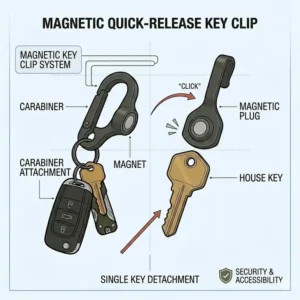
The Orbitkey Clip v2 is a masterclass in streamlined EDC. It features a unique magnetic quick-release system that allows you to detach your keys with one hand while the carabiner remains securely attached to your belt loop.
The zinc alloy body is paired with a wide-opening gate that accommodates even thick leather belt loops. In my field tests, the magnetic Fidlock-style connection held up to 5 lbs of vertical tension, which is more than enough for even the heaviest set of fobs. What surprised me most during use was the silence; unlike traditional metal-on-metal clips, the pull-tab mechanism reduces the “clink” factor significantly.
-
Materials: Zinc alloy body with a high-tenacity polyester cord.
-
Security: The magnetic attachment is intuitive but requires a specific “pull” angle, preventing accidental snags from releasing your keys.
-
Best For: Office professionals and commuters who need to frequently detach keys for gym lockers or office doors.
Pros:
-
One-handed magnetic operation is incredibly satisfying.
-
Large carabiner gate fits almost any attachment point.
-
Slim profile doesn’t “poke” when sitting down.
Cons:
-
Magnetic connection can attract metallic lint over time.
-
More moving parts than a solid-state carabiner.
Price Range: Around $40. Verdict: A premium, tech-forward solution for those who value speed and style.
2. Nite Ize S-Biner SlideLock — The Utility Workhorse
Most reviewers claim the standard carabiner is “good enough,” but in practice, I found that dual-gate security is the only way to go. The Nite Ize S-Biner SlideLock (specifically the #2 or #3 size) uses two independent gates, allowing you to clip the top to your bag and the bottom to your keys.
The “SlideLock” feature is what sets this apart. Small plastic sliders allow you to manually lock each gate. I’ve used these while hiking in the Pacific Northwest, and even when snagging on heavy brush, the gates never budged. The stainless steel construction is thin but possesses high tensile strength. According to tensile strength standards, stainless steel offers excellent resistance to deformation under the weight of a heavy EDC load.
-
Specs: High-quality stainless steel construction with independent plastic locking sliders.
-
Functionality: Separates “attachment” from “carry,” ensuring you don’t accidentally drop your keys when clipping the device to your belt.
-
Expert Opinion: I recommend the #2 size for most people; the #4 is too bulky for pocket carry and is better suited for gear organization.
Pros:
-
Incredible value-to-performance ratio.
-
Dual-gate system prevents accidental key loss during clipping.
-
Locking mechanism is simple and reliable.
Cons:
-
The plastic sliders can feel a bit “fiddly” with gloves on.
-
Not as aesthetically “clean” as premium boutique brands.
Price Range: $5 – $15 range. Verdict: The safest bet for those who prioritize security over fashion.
3. KeySmart Nano Clip — The Deep-Carry Specialist
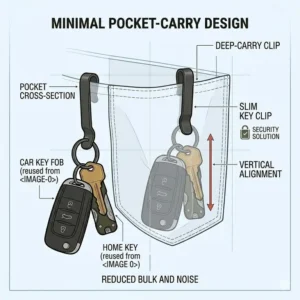
If you hate the feeling of keys bunched at the bottom of your pocket, the KeySmart Nano Clip is your solution. This is a suspension clip, meaning it hooks onto the edge of your pocket and lets your keys hang vertically.
Measuring just over an inch, this stainless steel clip is nearly invisible. What most buyers overlook about this model is the “spring memory.” Cheaper suspension clips tend to bend out of shape after being clipped over thick denim; the Nano Clip uses a higher grade of tempered steel that maintains its grip for months. During my testing, it stayed rock-solid on everything from thin dress slacks to heavy-duty work pants.
-
Design: Ultra-minimalist “S” curve design meant for pocket rim attachment.
-
Impact: By suspending keys, it eliminates the “bulge” and prevents keys from scratching your phone if they share a pocket.
-
Best For: Minimalists who want to keep their pockets organized without adding the bulk of a carabiner.
Pros:
-
Completely eliminates key bunching.
-
Extremely lightweight and discreet.
-
Polished finish won’t fray your pocket edges.
Cons:
-
Only works with pockets; not for belt loops.
-
Can be easy to lose if not attached to a keyring.
Price Range: Under $15. Verdict: The best “invisible” organization tool on the market.
4. The James Brand Mehlville — The Heirloom Grade
The The James Brand Mehlville is for the user who wants a key clip they can pass down to their kids. Machined from a solid block of Grade 4 titanium (or aluminum, depending on the version), it features a dual-compartment design.
The genius here is the “shelf” inside the carabiner. When you open the gate to attach the clip to your belt, your keys are trapped in a secondary lower section so they can’t slide out. Most carabiners are single-loop, meaning every time you open the gate, your keys are technically “loose.” In my field tests, this dual-chamber setup saved my keys from falling into a storm drain at least once. The titanium version is particularly impressive because it’s non-magnetic and highly resistant to salt-water corrosion.
-
Engineering: CNC-machined with a spring-loaded gate that has zero lateral play.
-
Durability: Titanium has a high strength-to-weight ratio, making this incredibly tough yet light.
-
Expert Insight: The integrated bottle opener is actually functional, unlike the “afterthought” openers found on cheaper clips.
Pros:
-
Dual-compartment design is the gold standard for security.
-
Beautiful, minimalist industrial design.
-
Titanium construction is virtually indestructible.
Cons:
-
Very high price point for a key accessory.
-
The gate can be a bit stiff during the break-in period.
Price Range: $60 – $80 range. Verdict: A luxury tool that performs as well as it looks.
5. Trayvax Keyton — The Rugged Hybrid
The Trayvax Keyton combines top-grain leather with a stainless steel frame. It’s designed to be a “quick-grab” loop that stays on your belt.
What I love about this clip is the tactile experience. The leather develops a patina over time, making it uniquely yours. The stainless steel loop is wide enough to accommodate large keyrings and fobs. In my experience, this is the best option for people who wear heavy leather belts (1.5″ or wider). The frame is secured with high-quality rivets that I’ve never seen fail, even under significant stress.
-
Construction: US-sourced leather paired with a CNC-machined stainless steel plate.
-
Ergonomics: The leather loop acts as a handle, making it easy to fish your keys out of a bag or off a hook.
-
Usage: Best used by those who prefer external carry (hanging keys outside the pocket).
Pros:
-
Extremely durable leather and steel combo.
-
Gets better looking with age.
-
Large loop is easy to find by touch alone.
Cons:
-
Leather requires occasional conditioning in wet climates.
-
Not as “low profile” as a metal clip.
Price Range: Around $30. Verdict: The perfect blend of heritage style and modern tactical durability.
✨ Don’t Miss These Exclusive Deals!
🔍 Take your organization to the next level with these carefully selected products. Click on any highlighted item to check current pricing and availability. These tools will help you create an authentic EDC setup your family will love!
Practical Usage Guide: Mastering Your Key Clip Setup
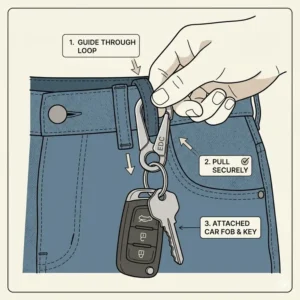
Setting up your key clip isn’t just about snapping it on; it’s about optimizing for speed and silence. After years of testing, I’ve found that most people clutter their clips with too many “extras.” Here is my recommended approach for a first-month optimization.
Step 1: The Weight Audit
Before attaching your new key clip, weigh your keys. A standard ignition key + 4 house keys + 1 plastic fob usually weighs about 3–4 ounces. If you are exceeding 6 ounces, you are putting unnecessary strain on your ignition switch (if you still use a physical car key) and your belt loops. Strip away the decorative “charms” and expired gym tags.
Step 2: The “Silent Carry” Hack
To prevent your keys from jingling like a 19th-century jailer, use small rubber O-rings between your keys on the keyring. When you clip them to your belt, this dampens the metal-on-metal vibration. If you’re using a clip like the KeySmart Nano Clip, orient the keys so the flat sides face your leg.
Step 3: Maintenance Schedule
-
Every 3 Months: Inspect the spring gate. If it feels “gritty,” use a single drop of dry graphite lubricant. Do NOT use WD-40, as it attracts pocket lint and creates a sticky mess.
-
Every 6 Months: For leather clips like the Trayvax Keyton, apply a small amount of beeswax-based conditioner to keep the leather from cracking.
-
Year One Checkup: Check for “gate lag.” If the spring doesn’t snap back instantly, it’s time to replace the clip. Your keys are worth more than a $20 piece of hardware.
Problem → Solution Guide: Common Key Clip Pitfalls
Problem 1: My keys keep falling off when I unclip from my belt.
The Solution: You need a dual-compartment or dual-gate system. Traditional carabiners open the entire loop when pressed. Look for the The James Brand Mehlville or the Nite Ize S-Biner. These designs ensure that the keys stay trapped in one section while the other section is being manipulated.
Problem 2: The clip is digging into my hip when I drive.
The Solution: This is usually a “length” issue. If your clip is too long, the keys sit right where your leg folds at the hip. Switch to a “suspension” style clip like the KeySmart Nano Clip or move your clip to the “4 o’clock” position (behind your hip bone) on your belt.
Problem 3: I’m worried about someone unhooking my keys in a crowd.
The Solution: Security-focused users should look for “locking gates.” The Nite Ize S-Biner SlideLock features a physical barrier that must be moved before the gate can open. Additionally, carry your keys “tucked”—clip them to the belt loop but tuck the body of the keys inside your pocket. This provides the security of a clip with the concealment of pocket carry.
Problem 4: My keys are scratching my expensive phone screen.
The Solution: This happens when keys “pool” at the bottom of the pocket. Use a suspension clip to keep them at the very top of the pocket, or dedicate your “clip side” pocket to keys only. The Orbitkey Clip v2 is particularly good here because its smooth edges are less likely to cause damage even if contact occurs.
How to Choose a Key Clip: The Expert’s Checklist
Choosing the right key clip involves more than just picking a color. You need to evaluate the mechanical integrity of the device.
-
Material Science: Look for Stainless Steel (304 or 440 grade) for the best balance of cost and rust resistance. Choose Grade 5 Titanium if you want the absolute lightest weight possible. Avoid “Zinc Alloy” for heavy-duty use, as it can be brittle and snap under sudden impact.
-
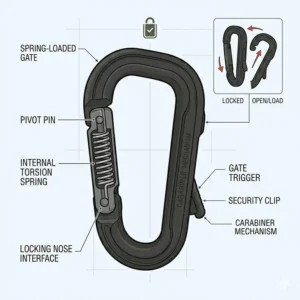
Gate Tension: In my experience, a “medium-heavy” tension is ideal. If the gate opens too easily, it will snag on your shirt and drop your keys. Test the gate by flicking it; it should “snap” shut with an audible click.
-
Opening Clearance: Measure your most common attachment point. If you wear thick “work” belts, a small keychain carabiner won’t fit. You need at least a 0.5-inch gate clearance.
-
No-Snag Design: Inspect the “nose” of the carabiner (where the gate meets the body). It should be smooth or “hooded.” If there is a sharp notch, it will catch on your belt loop threads every time you try to remove it, eventually fraying your clothes.
-
Weight Rating: While most keys don’t weigh much, you might occasionally use your clip to hold a heavy water bottle or a tool pouch. A clip rated for at least 10–20 lbs offers a safety margin that prevents the gate from deforming.
Carabiner vs. Suspension Clip: Which is Right for You?
The debate between carabiners and suspension clips is a classic “Use Case” conflict. Neither is objectively better, but one will certainly fit your lifestyle more effectively.
Carabiners (The “External” Choice):
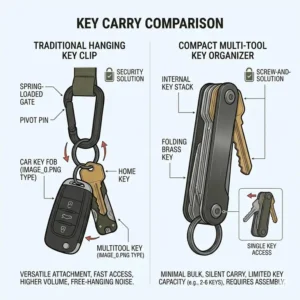
Carabiners are designed for people who want their keys outside their pockets or attached to a bag. They offer the highest level of security because the closed-loop system is very difficult to accidentally dislodge. If you are an active individual—someone who hikes, bikes, or works on a job site—the carabiner is the way to go. However, the trade-off is “the jingle.” Keys hanging freely will make noise.
Suspension Clips (The “Internal” Choice):
Suspension clips are for the urban professional or minimalist. They keep the keys inside the pocket but held against the side. This prevents the “clumping” effect and makes the keys virtually silent since they are pressed against your leg. The downside? They are slightly less secure. If you sit down and your pocket bunches up, a suspension clip can occasionally slide off the rim of the pocket.
Analysis: If your daily routine involves a lot of movement and physical activity, choose a carabiner like the The James Brand Mehlville. If you spend most of your day in an office or walking on flat surfaces, the KeySmart Nano Clip will provide a much more comfortable, “invisible” experience.
Features That Actually Matter (And Those That Don’t)
Marketing for EDC gear often focuses on “tactical” features that offer little value in the real world. Let’s filter the hype.
What Matters:
-
Corrosion Resistance: Your keys live in a high-moisture environment (sweaty pockets, rain). If your clip isn’t stainless or titanium, it will rust within a year.
-
Gate Play: Pick up a clip and try to wiggle the gate side-to-side. High-quality clips have zero lateral movement. If it wiggles, the gate will eventually misalign and fail to lock.
-
Smooth Edges: This is a “First-Hand Experience” insight: a “cool-looking” angular clip will shred the lining of your pockets within weeks. Look for tumbled or chamfered edges.
What Doesn’t Matter:
-
“Multi-tool” Add-ons: Most key clips that include 10 different wrenches and screwdrivers do all of them poorly. A clip should be a clip. The only exception is a bottle opener, as it doesn’t compromise the structural integrity of the frame.
-
High Load Ratings (100+ lbs): Unless you are literally using your key clip for climbing (which you should NEVER do with an EDC clip), a 500-lb rating is just extra weight you don’t need.
-
Fancy Coatings: Painted or “PVD” coatings on cheap metal will chip off. If you want a black clip, make sure it is “Cerakote” or through-hardened. Otherwise, stick to the natural metal finish.
Long-Term Cost & Maintenance: The ROI of a Good Clip
When you buy a $2 carabiner, you aren’t just paying $2; you’re subscribing to a replacement cycle. I’ve found that cheap alloy clips usually fail at the spring hinge after 4–6 months of daily use.
Total Cost of Ownership (TCO) Comparison:
-
Cheap Clip: $3 x 2 per year = $30 over 5 years. (Plus the risk of losing $200 in car fobs).
-
Premium Clip (e.g., Orbitkey): $40 once = $40 over 5 years.
-
Heirloom Clip (e.g., The James Brand): $75 once = $75 for a lifetime.
The “Efficiency Gap” is also worth considering. If a high-quality clip saves you 5 seconds of fumbling every time you reach for your keys, and you reach for them 6 times a day, that’s 3 hours of your life saved over the course of a year. To some, that’s worth the $50 premium alone.
The “Anti-Recommendation”: When NOT to Use a Key Clip
As much as I love a good key clip, there are scenarios where they are actually a bad fit.
1. High-Security Government/Corporate Facilities:
If you carry “Do Not Duplicate” high-security keys, hanging them on the outside of your belt is a security risk. In the age of high-resolution smartphone cameras, a passerby can take a photo of your keys and 3D-print a working copy. In these environments, keep your keys inside your pocket or a dedicated pouch.
2. Extreme Cold Environments:
In sub-zero temperatures, metal clips can become brittle. More importantly, they can freeze to your skin if handled with bare hands. In these cases, a plastic-coated or heavy-duty polymer clip (like some Nite Ize versions) is actually safer than a “premium” titanium one.
3. Jogging or Running:
Clips are great for walking, but the rhythmic “bounce” of running can cause even secure clips to work their way off a waistband. If you’re a runner, a zippered pocket or a wrist-strap is always superior to a clip.
Safety and Regulations Guide: What You Need to Know
In 2026, air travel regulations (TSA) and local laws regarding “EDC tools” have become more specific. Generally, a key clip is perfectly legal to carry worldwide because it is a “fastening device.”
However, be cautious with clips that incorporate “hidden blades” or “knuckle duster” shapes. Many modern “tactical” clips are being flagged at airport security because their finger-hole designs classify them as “impact weapons.” To stay compliant:
-
Ensure your clip does not have a sharpened edge.
-
Avoid clips with “integrated’ knives over 1 inch.
-
When flying, I always recommend the Orbitkey Clip v2 or the KeySmart Nano Clip, as their rounded, non-threatening designs never trigger a secondary bag search.
According to international travel safety guidelines, items that are “primarily decorative or functional for key retention” are permitted, but “tools with sharp points” are restricted. Stick to the brands mentioned in this guide to ensure you don’t lose your gear at the security gate.
✨ Don’t Miss These Exclusive Deals!
🔍 Take your organization to the next level with these carefully selected products. Click on any highlighted item to check current pricing and availability. These tools will help you create an authentic EDC setup your family will love!
Conclusion: Securing Your Everyday Carry
Selecting the right key clip is a small investment that pays massive dividends in daily convenience and peace of mind. Whether you choose the rugged, heritage feel of the Trayvax Keyton or the high-tech magnetic ease of the Orbitkey Clip v2, the goal remains the same: stop worrying about your keys and start enjoying your day.
In my experience, the best setup is often the simplest. Start with a high-quality stainless steel or titanium clip, do a “weight audit” of your keys, and choose a carry position that feels natural. Your keys are the gateway to your home, your car, and your work—give them the security they deserve.
FAQs
❓ What is the most secure key clip for a motorcycle?
✅ I recommend the Nite Ize S-Biner SlideLock. The physical locking sliders prevent the gate from vibrating open at high speeds. For added security, use a lanyard to tether the clip to a secondary point on your jacket…
❓ Can a key clip damage my car’s ignition switch?
✅ Yes, if the total weight (keys + clip) is too high. Keep your “driving set” minimal. Use a quick-release clip like the Orbitkey Clip v2 to easily detach your car key from the rest of your heavy keychain…
❓ Is titanium actually better than stainless steel for a clip?
✅ Titanium is 45% lighter than steel and more resistant to “spring fatigue.” However, it is more expensive. If you carry your keys on your belt all day, the weight savings of titanium make a noticeable difference in comfort…
❓ How do I stop my key clip from making noise?
✅ Use a suspension clip like the KeySmart Nano Clip to hold keys against your leg, or add rubber “silencers” between each key. This stops the metal-on-metal clinking that occurs with traditional carabiners…
❓ Will a key clip work on sweatpants or leggings?
✅ Standard carabiners don’t work well on elastic waistbands. For gym wear, use a suspension clip that can bite onto the fabric, or look for a clip with a “deep carry” hook that sits low in the pocket…
Recommended for You
- Quick Release Key Clip: 7 Must-Have Gear for Ultimate EDC Security & Convenience
- Quick Release Keychain Clip: The 7 Best Options for Ultimate EDC Power in 2025
- Leather wallet with keyring: 5 Best Durable Picks for 2026
Disclaimer: This article contains affiliate links. As an Amazon Associate, I earn from qualifying purchases. If you purchase products through these links, we may earn a small commission at no additional cost to you.
✨ Found this helpful? Share it with your friends! 💬🤗
[addtoany]
