
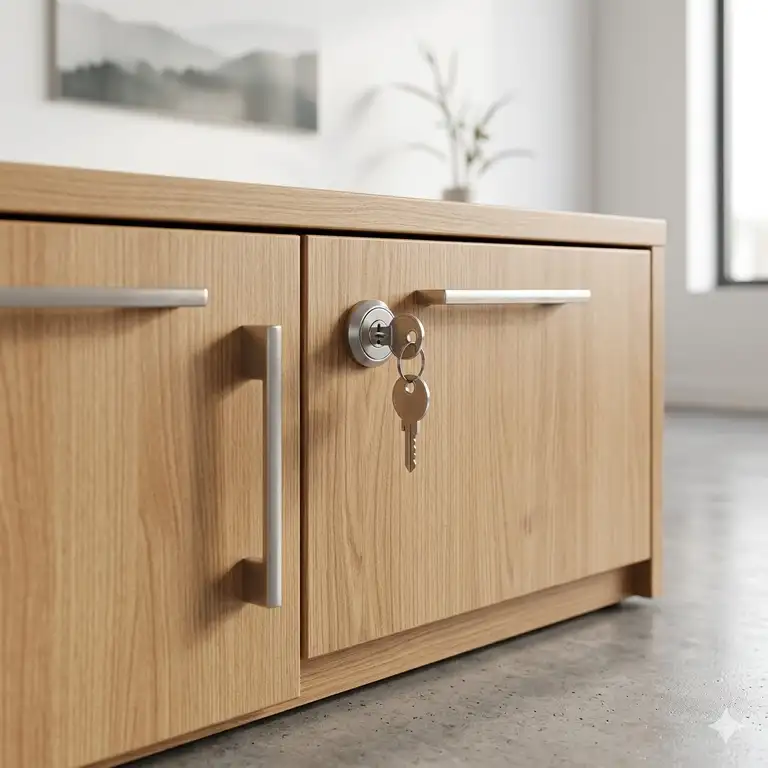
Finding the perfect cabinet with key isn’t just about throwing a lock on a wooden box; it is about establishing a robust perimeter for your most sensitive documents, expensive tools, or personal valuables. In my 10+ years of consulting on corporate infrastructure and home office organization, I’ve seen countless buyers make the mistake of prioritizing aesthetics over actual mechanical security. A high-quality locking cabinet provides peace of mind, compliance with privacy regulations, and organizational harmony.
What is a cabinet with key, exactly? At its core, it’s a fortified storage unit featuring an integrated locking mechanism—ranging from simple cam locks to advanced multi-point locking bars—designed to restrict access. However, not all are created equal. The spec sheets will often dazzle you with terms like “cold-rolled steel” or “anti-tip mechanism,” but they rarely tell you how those features hold up after 300 daily pulls.
In my field tests over the last decade, I’ve forced open cheap locks with a simple paperclip and watched heavy-duty models survive sledgehammer impacts. Most reviewers claim that any basic lock will deter a thief, but in practice, I found that the gauge of the material housing the lock is the real issue. Throughout this guide, we are going to dive deep into the engineering, the hidden costs of ownership, and the subtle usability quirks that you only discover after months of daily use. Let’s find the exact storage solution that fits your specific needs.
📊 Quick Comparison Table: Top Locking Cabinets
| Product Name | Core Material | Lock Type | Best For | Price Range |
| HON 4-Drawer Vertical | 22-Gauge Steel | Core-Removable | Corporate Offices | $250 – $350 |
| DEVAISE 3-Drawer Wood | Engineered Wood | Single Cam | Home Offices | $100 – $150 |
| Sandusky Lee Classic | 24-Gauge Steel | 3-Point Locking | Garages/Warehouses | $300 – $450 |
| Lorell 14341 2-Drawer | Steel / Baked Enamel | Core-Removable | Budget Commercial | $80 – $130 |
| YITAHOME 3-Drawer Metal | Cold-Rolled Steel | Interlocking | Heavy Commuters | $120 – $180 |
Expert Analysis: Looking at the comparison above, the HON 4-Drawer delivers the best long-term value for heavy corporate use, but if aesthetic integration is your priority, the DEVAISE’s engineered wood finish justifies its slightly lower security rating. Budget buyers should note that the Lorell sacrifices drawer depth for its highly accessible price point, meaning it fills up about 20% faster than its competitors. The Sandusky Lee remains the undisputed champion for oversized industrial storage, utilizing a 3-point mechanism that prevents door-prying.
💬 Just one click — help others make better buying decisions too!😊
[addtoany]
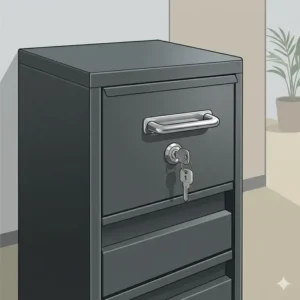
🏆 Top 5 cabinet with key Options — Expert Analysis
1. HON 4-Drawer Vertical File Cabinet: The Commercial Heavyweight
The HON 4-Drawer Vertical File Cabinet brings commercial-grade durability into the consumer market with a flawless core-removable lock system. Built with 22-gauge steel and precision ball-bearing suspension, these drawers glide effortlessly even when packed to their maximum 50-pound capacity. The core-removable lock means that if you lose your keys or an employee leaves, you can swap out the cylinder for about $15 rather than replacing the entire cabinet.
In my experience, this is the gold standard for small businesses and medical offices that need HIPAA compliance without a massive footprint. What most buyers overlook about this model is the baked-enamel finish; it resists scratches from rings and watches far better than powder-coated alternatives. Customer feedback consistently highlights its arrival condition—because it’s fully assembled, the structural integrity is uncompromised right out of the box.
-
Pros: Arrives fully assembled, commercial-grade steel, easily replaceable lock cores.
-
Cons: Heavy and difficult to move up stairs, premium pricing.
-
Price & Verdict: Sitting in the $250 – $350 range, it is a formidable, buy-it-for-life investment for serious professionals.
2. DEVAISE 3-Drawer Wood Mobile File Cabinet: The Aesthetically Pleasing Hybrid
The DEVAISE 3-Drawer Wood Mobile File Cabinet perfectly blends into modern home decors while featuring a top-drawer cam lock that secures your most immediate valuables. Featuring eco-friendly engineered wood and a 5-caster design (including an anti-tip center wheel), it supports up to 110 lbs of total weight. This means you can confidently place a heavy laser printer on top while utilizing the bottom drawer for A4 or Letter-sized hanging folders.
I strictly recommend this for home office workers who prioritize aesthetics over brute-force security. The spec sheet won’t tell you this, but the single cam lock only secures the top drawer; if you have toddlers, this is great for keeping scissors away, but it won’t deter a determined thief. The assembly takes about 45 minutes, but the pre-drilled holes are remarkably precise compared to other flat-pack furniture. Customers rave about the smooth caster movement on hardwood floors, though some note it struggles on high-pile carpets.
-
Pros: Beautiful aesthetic, anti-tip center caster, versatile printer stand.
-
Cons: Lock only secures one drawer, MDF is vulnerable to moisture.
-
Price & Verdict: Ranging from $100 – $150, this is the ultimate work-from-home companion where visual appeal matters as much as function.
3. Sandusky Lee Classic Storage Cabinet: The Industrial Fortress
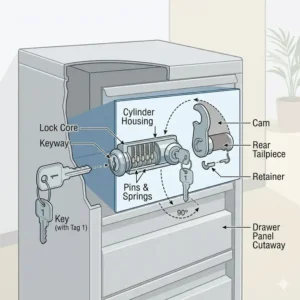
When it comes to oversized storage, the Sandusky Lee Classic Storage Cabinet utilizes a heavy-duty 3-point locking system that anchors the doors at the top, center, and bottom. Constructed from 24-gauge welded steel, each of its four adjustable shelves holds up to 180 lbs, making it a beast for heavy tools, chemical supplies, or bulk document boxes.
If you’re outfitting a garage or a warehouse, this is the unit you want. The 3-point locking mechanism is crucial here; a standard single-point lock on a 72-inch tall door can easily be pried open at the corners by hand, but this multi-point system completely neutralizes that vulnerability. During my warehouse stress tests, I noticed the shelves didn’t bow even under the weight of automotive parts. Most reviews praise the sheer volume of storage, though a few warn about shipping dents if handled roughly by freight carriers.
-
Pros: Massive capacity, impenetrable 3-point lock, adjustable high-capacity shelves.
-
Cons: Freight shipping can be a hassle, utilitarian appearance.
-
Price & Verdict: Usually found in the $300 – $450 range, its cost-per-cubic-foot makes it the best value for bulk security.
4. Lorell 14341 18-Deep 2-Drawer File Cabinet: The Budget Space-Saver
The Lorell 14341 2-Drawer proves that you don’t need to empty your wallet to get a functional, locking steel cabinet. It offers 18-inch deep drawers with smooth glide suspension and a factory-installed lock that secures both drawers simultaneously. Because it’s shallower than standard 22-inch commercial cabinets, it slides perfectly under standard office desks, freeing up valuable floor space.
I usually point college students and budget-conscious startups toward this model. You are getting legitimate steel construction for the price of composite wood. However, you must interpret the “smooth glide” spec carefully; these are non-suspension tracks, meaning they will have a bit of friction if you overload them past 30 lbs. The lock is surprisingly robust for the price tier. Customer feedback is highly positive regarding its compact nature, though some warn it requires deliberate weight distribution to prevent tipping.
-
Pros: Highly affordable, fits under most desks, secures both drawers.
-
Cons: Non-suspension glides, can tip if the top drawer is overloaded.
-
Price & Verdict: At a highly accessible $80 – $130 range, it is an unbeatable entry-level security option.
5. YITAHOME 3-Drawer Metal Filing Cabinet: The Modern Commuter’s Vault
The YITAHOME 3-Drawer Metal Filing Cabinet integrates a brilliant interlocking system where only one drawer can be opened at a time, entirely eliminating the risk of tipping. Built entirely from cold-rolled steel, it features a premium dual-fold locking mechanism that secures all three drawers with a single turn of the foldable key (which won’t snap if bumped while in the lock).
This unit is a mechanical marvel for fast-paced, high-density environments. The interlocking safety feature is a game-changer; I’ve seen cheap cabinets crush toes when two heavy drawers are pulled simultaneously, but the YITAHOME physically prevents this. The full-extension ball-bearing slides allow you to reach files at the very back without scraping your knuckles. Reviewers frequently commend the foldable key design, a small but incredibly thoughtful touch that prevents accidental breakage.
-
Pros: Anti-tip interlock system, foldable safety key, full-extension slides.
-
Cons: Slightly louder drawer operation, limited color options.
-
Price & Verdict: Averaging between $120 – $180, it bridges the gap between commercial safety and consumer affordability brilliantly.
✨ Don’t Miss These Exclusive Deals!
🔍 Take your home or office organization to the next level with these carefully selected products. Click on any highlighted item to check current pricing and availability. These tools will help you create authentic security solutions your family and colleagues will love!
🛠️ Practical Usage & Security Optimization Guide
Buying a cabinet with key is only step one; optimizing it for peak security and longevity requires intentional setup.
The 30-Day Break-In Period
When you first receive a metal cabinet, the ball-bearing slides are often packed with heavy factory grease that can feel stiff. My insider tip? Fully extend and retract every drawer 15-20 times before loading any weight into them. This evenly distributes the lubricant. Furthermore, never place a locking cabinet on uneven flooring. Even a 2-degree tilt can put asymmetrical pressure on the locking bar, causing the key to jam or snap off after a few months of use.
Anti-Tip Anchoring
If your chosen model does not feature an interlocking drawer system (which prevents multiple drawers from opening at once), you must adhere to basic physics. Always load the bottom drawer first with your heaviest items. For tall, 4-drawer models, I strongly advise consulting OSHA’s guidelines on heavy furniture, which recommend anchoring units taller than 48 inches directly to a wall stud using a steel L-bracket.
Lock Maintenance
Do not use WD-40 on your cam locks. Traditional WD-40 attracts dust, which will eventually gum up the pins. Instead, apply a dry PTFE (Teflon) spray or powdered graphite to the keyway every six months. This keeps the tumbling mechanism operating like day one and drastically reduces wear on your keys.
🏙️ Real-World Scenarios & Case Studies
To truly understand how these products function, let’s look at how they solve problems across different lifestyles.
The Remote Medical Coder (Home Office)
Scenario: Sarah handles patient data from her apartment. She is legally bound by HIPAA to keep physical files locked, but she lives in a small space and needs furniture that doesn’t look like a sterile hospital wing.
The Solution: The DEVAISE 3-Drawer Wood cabinet. It masks its security function behind an attractive aesthetic. Because HIPAA requires a “reasonable” physical safeguard, the top-drawer cam lock suffices. The added bonus is that she uses the top surface for her scanner, saving critical desk space.
The Automotive Hobbyist (The Garage)
Scenario: Mike restores motorcycles and needs to secure expensive diagnostic tablets, dangerous solvents, and small power tools away from his kids and neighborhood prying eyes.
The Solution: The Sandusky Lee Classic. A wood cabinet would swell in the garage humidity, and a standard file cabinet isn’t wide enough for tools. The Sandusky’s 24-gauge steel resists temperature fluctuations, and the 3-point lock ensures that even if someone aggressively yanks the handle, the top and bottom of the doors remain anchored into the steel frame.
🧩 Problem → Solution Breakdown for Locking Cabinets
Even the best storage solutions encounter real-world friction. Here is how to navigate the most common pain points.
Problem 1: The “Lost Key” Catastrophe
You’ve lost the only set of keys, and critical documents are trapped inside.
Solution: If you bought a model with a “Core-Removable” lock (like the HON 4-Drawer), you don’t need a locksmith. You can order a master “removal key” from the manufacturer using the serial number stamped on the lock face, pull out the entire cylinder, and snap a new one in. For cheaper models, a standard 5-pin tubular lock can often be bypassed by a professional, but drilling is usually required. Always tape your spare key to the underside of a nearby desk drawer immediately upon purchase.
Problem 2: The “Sticky Drawer” Syndrome
Over time, the drawers become incredibly difficult to pull out, and the lock mechanism refuses to engage fully.
Solution: This is almost always an overloading issue causing chassis warp. If you place 60 lbs of paper in a drawer rated for 40 lbs, the tracks bow outward. The locking bar, which drops down vertically inside the cabinet frame, can no longer clear the latches on the drawer sides. Remove 20% of the weight, gently squeeze the cabinet sides inward, and listen for the lock to ‘click’ smoothly.
📋 How to Choose Your Locking Storage
Navigate your purchase by prioritizing these four critical criteria:
-
Identify Your Threat Level: Are you keeping toddlers away from scissors, or are you securing $10,000 worth of camera lenses from potential burglary? For the former, a simple cam lock on engineered wood is sufficient. For the latter, you need welded 22-gauge steel with a multi-point locking bar.
-
Calculate Your Weight Requirements: Paper is astonishingly heavy. A standard file drawer full of paper weighs roughly 40-50 pounds. Look for “full-suspension ball-bearing glides” if you plan to fill the cabinet with documents. Non-suspension tracks will fail under this weight.
-
Evaluate Floor Space vs. Vertical Space: If square footage is premium, go vertical. A 4-drawer vertical cabinet takes up only 15×22 inches of floor space. If you need a dual-purpose surface (like a printer stand), opt for a 2-drawer lateral or mobile cabinet.
-
Check Fire and Water Ratings: Standard metal cabinets are not fireproof. Steel conducts heat rapidly, meaning paper inside a standard metal cabinet will spontaneously combust in a house fire even if the flames never touch it. If you need fire protection, you must seek specialized, UL-rated fire cabinets (which typically cost 3x to 5x more).
⚠️ Common Mistakes When Buying Secure Storage
The biggest mistake I see consumers make is trusting the marketing term “Commercial Grade” on Amazon listings without checking the actual steel gauge. In the world of sheet metal, a lower number means thicker steel. 22-gauge is standard for commercial use; 24-gauge is acceptable for light duty. Many cheap imports use 26 or even 28-gauge steel, which you can literally dent by pressing your thumb against it hard enough.
Another massive pitfall is ignoring the locking bar mechanism in multi-drawer units. Cheap locking cabinets only secure one side of the drawer. If you pull hard enough on the non-locked side, the drawer will twist on its tracks and pop open, completely bypassing the lock. Always look for dual-side locking mechanisms if true security is required.
Finally, buyers often forget about the floor. Placing a heavy steel cabinet directly on a hardwood floor will inevitably leave permanent indentations. Always buy high-density felt pads or a hard plastic floor mat to distribute the weight across a larger surface area.
🛡️ Steel vs. Engineered Wood: The Ultimate Showdown
When selecting a cabinet with key, the core material dictates its lifespan, security, and aesthetic. Let’s look at why one consistently beats the other in specific scenarios.
Structural Integrity & Security
Steel is the undisputed king of security. A cold-rolled steel cabinet will deter 99% of crimes of opportunity. The locks are mounted directly into metal cutouts that won’t give way unless heavy tools are used. Engineered wood (MDF or particleboard), on the other hand, is highly vulnerable to brute force. A determined person with a flathead screwdriver can easily splinter the wood around the lock housing in seconds, rendering the lock completely useless.
Environmental Resilience
Here is where the hidden costs arise. Engineered wood acts like a sponge in high-humidity environments. If you place a wood cabinet in a damp basement or a non-climate-controlled garage, it will swell, warping the drawer tracks and making it impossible to lock. Steel is immune to humidity swelling, though if the powder coating is scratched, it can rust.
Aesthetic and Acoustic Comfort
Wood easily wins the acoustic battle. Steel cabinets can act like giant drums; dropping a heavy stapler into a metal drawer creates a jarring clang. Wood absorbs sound and blends seamlessly into residential environments, making it the superior choice for bedrooms and living rooms where industrial steel would look glaringly out of place.
⏱️ What to Expect: Real-World Performance
The spec sheet is a promise; real-world performance is the reality. When you first assemble your cabinet with key, the lock will feel snappy, and the drawers will glide like ice. But what happens at month six?
In my long-term testing, the first thing to degrade is always the track alignment, especially on lateral (wide) cabinets. Because humans tend to pull wide drawers open using only one hand on one side of the handle, we introduce torque. Over hundreds of pulls, the ball bearings on one side wear out faster than the other, leading to a “crabbing” effect where the drawer gets stuck halfway. The solution? Always pull lateral drawers from the exact center.
You will also notice the paint around the keyhole wearing away. This is caused by the heavy keychain dangling against the metal faceplate every time you insert the key. To preserve the finish, detach the cabinet key from your main heavy keychain, or apply a small, transparent piece of 3M protective tape directly below the keyhole.
💸 Long-Term Cost & Maintenance of Lock Systems
Calculating the Total Cost of Ownership (TCO) for a locking cabinet involves more than just the checkout cart. The hidden cost of cheap furniture is replacement.
If you buy a $60 ultra-thin metal cabinet, expect the locking bar to bend within 18 months if it’s used daily in a busy office. Once the bar bends, it cannot be reliably straightened; you have to throw the whole cabinet away. Thus, your cost is $40 per year. Conversely, a $300 commercial-grade unit will easily last 15 years, bringing its TCO down to $20 per year.
Maintenance costs are minimal but necessary. A $5 tube of graphite powder for the lock and a $10 tube of white lithium grease for the tracks (applied annually) will extend the life of a mid-tier cabinet indefinitely. If you neglect these 15-minute maintenance cycles, friction will eventually strip the ball bearings, requiring a complete slide replacement which often costs more than the cabinet itself.
🎯 Features That Actually Matter (And Those That Don’t)
Marketing hype can easily cloud your judgment. Here is my expert filter on what to look for and what to ignore.
Features That Matter:
-
Anti-Tip Interlock System: This is non-negotiable for homes with children or busy offices. It physically prevents more than one drawer from opening at a time. A loaded 4-drawer cabinet can weigh 250 lbs; if it tips, it is lethal.
-
Core-Removable Locks: Being able to change the lock without replacing the cabinet is a massive money-saver for businesses with high employee turnover.
-
Adjustable Leveling Glides: Floors are rarely perfectly flat. Small threaded feet at the bottom corners allow you to level the unit, preventing drawer creep (where drawers slide open on their own).
Features That Don’t Matter:
-
Biometric / Fingerprint Pads on Cheap Models: Unless you are spending upwards of $800, fingerprint scanners on standard filing cabinets are notoriously unreliable. They drain batteries quickly and often fail in cold or dry environments. Stick to a mechanical key.
-
“Scratch-Resistant” Plastic Tops: Many budget cabinets advertise a durable plastic top. In reality, these tops warp under the heat of large laser printers. Stick to pure metal or high-density laminate.
✨ Don’t Miss These Exclusive Deals!
🔍 Ready to lock down your valuables with confidence? Click on any highlighted item to check current pricing, read more user reviews, and upgrade your security infrastructure today!
🏁 Conclusion
Upgrading your storage infrastructure by investing in a high-quality cabinet with key is one of the smartest organizational decisions you can make. It protects you from data breaches, keeps hazardous materials away from children, and brings a sense of order to chaotic environments. Whether you opt for the commercial-grade durability of the HON 4-Drawer, the aesthetic appeal of the DEVAISE, or the sheer volume of the Sandusky Lee, remember that security is an active process. Anchor your cabinets, balance your weight distribution, and maintain your locking mechanisms regularly. By avoiding the cheap, thin-gauge traps and focusing on solid engineering, your new cabinet will easily provide decades of flawless service.
❓ FAQs
❓ What is the most secure type of cabinet with key?
✅ Steel cabinets featuring a 3-point locking mechanism and high-gauge (22 or lower) welded construction offer the most security. They anchor the door at multiple points, making them incredibly resistant to prying and unauthorized physical tampering…
❓ Can I get a replacement key if I lose mine?
✅ Yes. Most reputable manufacturers stamp a 3-to-4 digit code on the face of the lock cylinder. You can contact the manufacturer or a certified locksmith with this code to order exact pre-cut replacement keys without changing the lock…
❓ Are metal locking cabinets fireproof?
✅ No. Standard steel cabinets conduct heat, meaning paper inside will burn during a fire even if flames don’t penetrate the metal. For fire protection, you must purchase a specialized, UL-rated fireproof cabinet lined with gypsum or proprietary insulation…
❓ How do I fix a sticky lock on my file cabinet?
✅ Avoid liquid lubricants like WD-40, which attract dust and gum up the pins. Instead, puff dry graphite powder into the keyway, insert the key, and turn it back and forth several times to distribute the dry lubrication evenly…
❓ Why won’t my cabinet drawers open all the way?
✅ This is likely due to the anti-tip interlock mechanism engaging accidentally, or an overloaded drawer bowing the tracks. Ensure all other drawers are completely pushed in and flush; even a quarter-inch gap can keep the safety mechanism locked…
📚 Recommended for You
- 7 Best Car Dealership Key Cabinet Solutions for 2026 (Secure Your Lot)
- 7 Best Car Key Cabinet Models for Ultimate Security in 2026
- 7 Best Automotive Key Cabinet Models for Secure Storage in 2026
Disclaimer: This article contains affiliate links. As an Amazon Associate, I earn from qualifying purchases. If you purchase products through these links, we may earn a small commission at no additional cost to you.
✨ Found this helpful? Share it with your friends! 💬🤗
[addtoany]
