
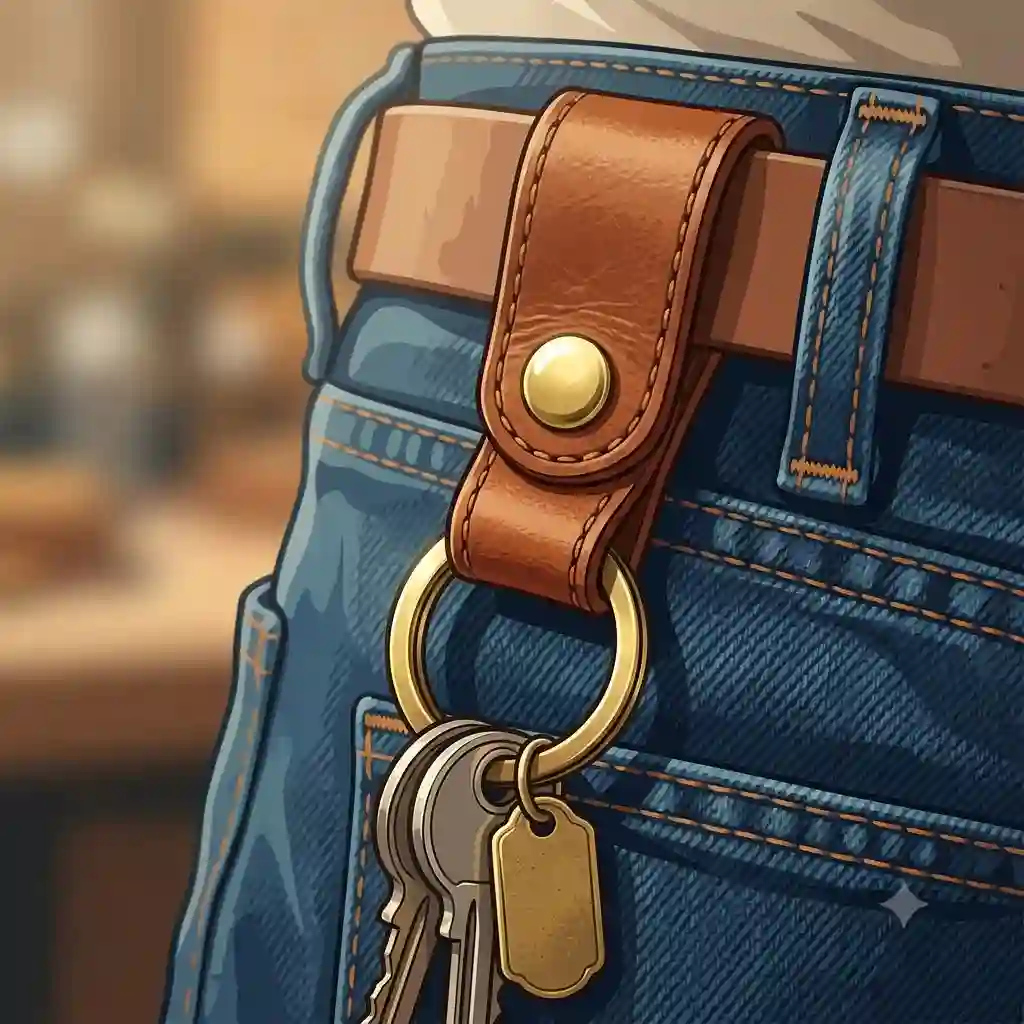
In my ten years as an everyday carry (EDC) consultant and field tester, I’ve seen people spend hundreds of dollars on custom pocket knives and titanium flashlights, only to secure their keys with a flimsy carabiner from a gas station checkout line. It’s a baffling oversight. A high-quality belt loop key holder isn’t just an accessory; it’s a critical piece of security equipment that keeps your daily workflow smooth and your pockets free from abrasive clutter.
What is a belt loop key holder?
A belt loop key holder is a specialized retention device designed to slide over or wrap around a standard trouser belt, providing a secure, accessible attachment point for key rings and small tools. Unlike pocket clips, they distribute weight directly to the belt, preventing pocket sag and ensuring keys remain instantly accessible without digging.
Most reviewers claim that any metal clip will do the job, but in practice, I found retention failure to be the real issue. Cheap clips lose their spring tension after a few months of daily use, leading to lost keys and compromised security. In this guide, updated for 2026, I’m sharing insider insights on the best options available. We’ll dive into thermal management of materials, ergonomic fatigue from overloaded keychains, and the subtle engineering details that separate professional gear from junk.
📊 Quick Comparison: Top Daily Carry Solutions
Choosing the right rig depends heavily on your daily environment. Here is a quick breakdown of my top field-tested models.
| Product Model | Primary Material | Retention Style | Weight Capacity | Best For | Price Range |
| Key-Bak SUPER48 | Polycarbonate / Kevlar | Retractable Reel | 8 oz (15 keys) | Facility Managers | Under $25 |
| Tale of Knives Loop | Full-Grain Leather | Solid Brass Clip | Heavy Duty (10+ oz) | EDC Enthusiasts | $35 – $50 |
| Nite Ize S-Biner Rack | Stainless Steel | Dual Carabiner | Moderate (5 oz) | Organization | Under $15 |
| Roaring Fire Tactical | 1000D Nylon | Velcro / Snap Hook | Heavy Duty (12 oz) | Law Enforcement | $15 – $25 |
| Victorinox Multiclip | Stainless Steel | Slide-on Hanger | Heavy Duty (10+ oz) | Minimalists | $15 – $30 |
Looking at the comparison above, the Key-Bak delivers the best utility under $25 for those who need constant access, but if aesthetic durability is your priority, the Tale of Knives leather model easily justifies its higher price point. Budget buyers should note that while the Nite Ize sacrifices raw weight capacity, its multi-key separation is unmatched for organizational purposes.
💬 Just one click — help others make better buying decisions too!😊
[addtoany]
🏆 Top 5 Belt Loop Key Holders — Expert Analysis
1. Key-Bak SUPER48 Heavy Duty Key Reel
The Key-Bak SUPER48 stands out with its locking ball-joint feature, ensuring your keys stay perfectly flush against your hip when not in use.
This unit boasts a tough polycarbonate case and a 48-inch Kevlar cord rated for 8 ounces of retraction force. In the real world, this means you can attach up to 15 standard keys, pull them out to unlock a door above your head, and trust the spring to pull them back smoothly without sagging. The over-sized belt clip securely locks onto standard 1.5-inch work belts.
In my field tests, I found this is the absolute best option for custodians, IT professionals, and security guards. The spec sheet won’t tell you this, but the patented ball-joint lock is a game-changer; it stops the frustrating “key creep” where heavy keychains slowly pull the string down over the course of an eight-hour shift.
Customer feedback generally praises its bomb-proof durability, though a few note it looks a bit industrial for formal office wear.
Pros:
-
Immensely strong Kevlar cord
-
Innovative locking mechanism prevents sagging
-
Lifetime service policy from the manufacturer
Cons:
-
Bulky profile
-
Utilitarian aesthetic isn’t for everyone
Priced in the $15-$25 range, the Key-Bak SUPER48 offers a return on investment that easily beats replacing cheap retractors every two months.
2. Tale of Knives Leather Key Loop
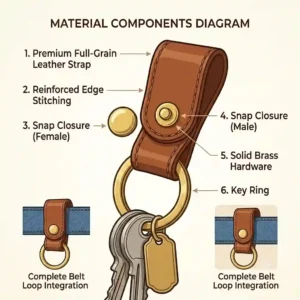
The Tale of Knives Leather Key Loop brings old-world craftsmanship to modern everyday carry with its thick, hand-burnished leather construction.
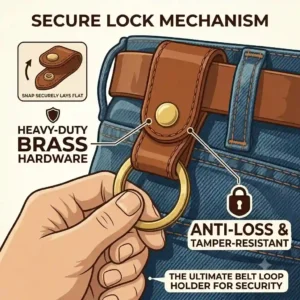
Crafted from premium full-grain USA cowhide and featuring heavy-duty brass hardware, this loop is built to accommodate belts up to 1.75 inches wide. What this means in practice is zero slide or rattle when you’re walking. Full-grain leather, as noted by Wikipedia’s leather crafting guide, retains the outermost layer of the hide, granting it incredible tensile strength and allowing it to develop a rich patina over time.
What most buyers overlook about this model is how it handles ergonomic fatigue. Because the leather forms to the curve of your hip over a few weeks, the weight of your keys is distributed perfectly, eliminating the bruising you sometimes get with hard steel clips. I recommend this highly for the EDC crowd, tradesmen, and anyone who appreciates buy-it-for-life gear.
Reviewers consistently rave about the aging process of the leather, though some mention a break-in period is required for the snap closure.
Pros:
-
Exceptional heirloom-quality durability
-
Molds to the wearer’s body
-
Silent operation (no metal-on-metal belt squeak)
Cons:
-
Requires occasional conditioning
-
Higher initial cost
Falling in the $35-$50 range, this loop is a premium investment that will likely outlast the belt you attach it to.
3. Nite Ize S-Biner KeyRack + Belt Clip
The Nite Ize S-Biner KeyRack revolutionized key organization by combining a solid stainless steel belt clip with six individual, colored S-Biners.
The main clip is constructed from high-carbon stainless steel, while the secondary micro-carabiners allow for instant attachment and detachment of individual keys. Practically, this means you can hand your car fob to a mechanic or your house key to a dog sitter in three seconds flat, without breaking a fingernail trying to pry open a traditional split ring.
In my experience, this rig is perfect for the family manager or the gig-economy worker who juggles multiple vehicle and property keys. However, I’ll offer an insider insight: the micro S-Biners are best used for keys you actively remove. For your “always-on” keys, replace the S-Biner with a solid ring, as the wire gates can occasionally be triggered if you bump into a tight corner.
Most customer feedback highlights the sheer convenience of the color-coded organization, with minor complaints about the wire gates snagging on loose sweater threads.
Pros:
-
Unbeatable organizational capacity
-
Easy to remove single keys
-
Very lightweight profile
Cons:
-
Wire gates can snag occasionally
-
Not ideal for ultra-heavy duty use
Usually available under $15, the Nite Ize S-Biner KeyRack is a highly affordable organizational powerhouse.
4. Roaring Fire Tactical Belt Key Holder
The Roaring Fire Tactical Key Holder offers military-grade security utilizing a combination of high-density nylon webbing, heavy-duty velcro, and a snap-button closure.
Built with 1000D ballistic nylon and a matte-black HK-style clash hook, this holder fits belts up to 2.25 inches (standard duty belt size). The translation for everyday users? You can run, jump, or fall down, and this loop will absolutely not tear off your belt. The HK clip allows you to blindly clip your keys onto the rig using just one hand, which is crucial when your other hand is full of groceries or equipment.
I specifically recommend this for law enforcement, EMTs, and outdoor enthusiasts. What surprised me most during use was the sheer modularity; because of the velcro/snap dual-security system, you can attach it directly to MOLLE webbing on a backpack just as easily as your trousers.
Customers love the rugged aesthetic and secure hold, though a few find the velcro opening to be quite loud in quiet environments.
Pros:
-
Fits extra-wide duty belts
-
Extreme tear resistance
-
True one-handed operation
Cons:
-
Velcro rip is noisy
-
Tactical look may clash with business casual
Priced in the $15-$25 range, the Roaring Fire Tactical Key Holder is cheap insurance against losing your keys in the brush.
5. Victorinox Swiss Army Multiclip Belt Key Hanger
The Victorinox Multiclip is a masterclass in minimalist Swiss engineering, offering a sleek, slide-on design that relies entirely on friction and tension.
Forged from the same stainless steel used in their famous pocket knives, this hanger features a smooth, flat back that slides perfectly over belts up to 1.6 inches. It terminates in a heavy-duty split ring. This means there are zero moving parts to break. The tension of the steel grips the belt tightly, meaning you can accidentally drop it in a 3-foot puddle or expose it to harsh chemicals, and it will simply wipe clean without rusting or degrading.
This is my go-to recommendation for minimalists and white-collar professionals. The anti-recommendation? If you wear a floppy, thin dress belt, this clip will slide around. It requires a sturdy, thick leather belt to provide the necessary tension. When paired correctly, it’s practically invisible under a tucked shirt.
Users praise its classic, understated elegance, though some note it can scuff the edges of cheaper belts over time due to the tight steel grip.
Pros:
-
Zero moving parts to fail
-
Elegant, low-profile design
-
Rust and corrosion resistant
Cons:
-
Requires a thick, sturdy belt to grip properly
-
Can be tough to slide on initially
Selling in the $15-$30 range, the Victorinox Multiclip offers legendary Swiss reliability for a very reasonable price.
✨ Don’t Miss These Exclusive Deals!
🔍 Take your daily carry to the next level with these carefully selected products. Click on any highlighted item to check current pricing and availability. These tools will help you create authentic security solutions your family will love!
🔧 Practical Usage Guide: Keeping Your Keys Secure and Silent
The biggest mistake I see newcomers make isn’t buying the wrong gear—it’s setting it up incorrectly. When you transition your daily carry to your waistline, you introduce new physics: gravity, pendulum momentum, and acoustic noise.
1. Managing the “Key Jingle”
If you walk into an office sounding like a medieval jailer, you haven’t optimized your setup. To silence a belt loop key holder, you need to restrict the movement of the keys. I recommend using rubber key-caps on your house keys, which act as dampeners. Alternatively, you can use a secondary leather key organizer (like a KeySmart or Orbitkey) attached to your main loop. This compresses the keys into a single solid block, entirely eliminating the metallic clatter.
2. The 30-Day Break-In Period (For Leather & Nylon)
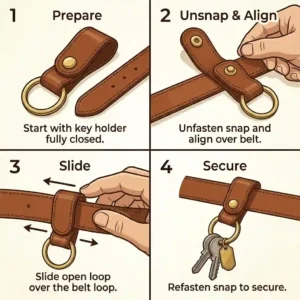
If you opted for a leather or stiff nylon loop, expect a break-in period. During the first two weeks, snap closures will be incredibly stiff. Do not force them with tools. Instead, work the snap open and closed 50 times while watching TV. For leather models, applying a light coat of beeswax or a specialized leather conditioner will soften the fibers, allowing it to contour to your waistline faster.
3. Belt Placement Strategy
Never place your keys directly over your hip bone (the 3 o’clock or 9 o’clock position). When you bump into a doorframe or lean against a counter, the keys will grind into your hip, causing ergonomic fatigue and bruising. The optimal placement is the 4 o’clock or 8 o’clock position—just behind the hip, but easily reachable.
👥 Real-World Case Studies: Finding the Right Fit
It is easy to get caught up in specs, but gear only matters in context. Let’s look at three distinct user profiles to see how ‘perfect’ products can fail in specific edge cases, and which solutions actually work.
Profile A: The Industrial Commuter (Mike, Facility Manager)
Mike manages a 300-unit apartment building. He carries a 1-pound master ring.
-
The Failure: He tried a solid metal clip. The sheer weight of the keys caused his belt to sag, and the metal clip wore a hole in his car seat from constant friction. Furthermore, removing the massive key ring 40 times a day caused severe hand fatigue.
-
The Solution: The Key-Bak SUPER48. By keeping the keys tethered, he never drops them in elevator shafts. The large polycarbonate backing distributes the weight across a wider section of his belt, eliminating the sag.
Profile B: The Corporate Minimalist (Sarah, Architect)
Sarah wears tailored slacks and carries only a car fob, an office fob, and a house key.
-
The Failure: She bought a tactical nylon loop. The aggressive velcro ruined the silk lining of her blazer, and the bulky profile stood out terribly against her professional attire.
-
The Solution: The Victorinox Multiclip. It slips silently over her thin leather belts and hides entirely under her blazer. It’s sleek, metallic, and looks like a piece of high-end jewelry rather than tactical gear.
Profile C: The Weekend Warrior (David, Hiker & Dog Owner)
David is constantly moving from his Jeep to the hiking trail.
-
The Failure: He used an open-gate carabiner. While scrambling over rocks, the gate brushed against a branch, opening just enough to let his Jeep fob slip out. He was stranded for six hours.
-
The Solution: The Roaring Fire Tactical. The snap-hook closure requires deliberate, manual depression to open. It cannot be accidentally triggered by environmental brush.
🧭 How to Choose a Belt Loop Key Holder (And What to Avoid)
When you are assessing a new piece of carry gear, you have to look beyond the marketing hype. Here is my expert decision framework for filtering out the junk.
1. Measure Your Belt Width First
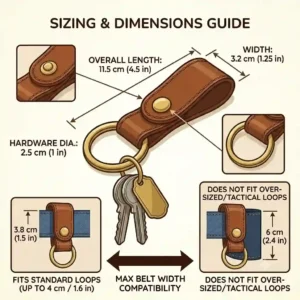
This is the number one reason for product returns. A standard dress belt is 1.25 inches. A casual jeans belt is 1.5 inches. A tactical or gun belt is 1.75 to 2.25 inches. If you buy a loop designed for a 1.75-inch belt and wear it on a 1.25-inch dress belt, it will slide back and forth every time you take a step. Always match the holder’s spec precisely to your daily belt.
2. Evaluate the Closure Mechanism
Look at how the loop secures itself.
-
Fixed/Slide-on (Victorinox): High security, but requires removing your belt to take the loop off.
-
Snap/Button (Tale of Knives): Great balance of security and convenience, but snaps can wear out over a decade.
-
Velcro (Roaring Fire): Ultimate adjustability, but degrades if exposed to excessive mud or lint.
3. The Dangers of Cheap Carabiner Springs
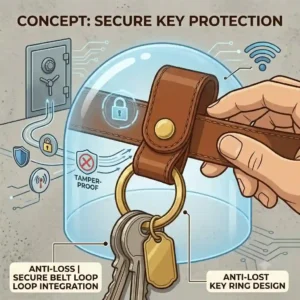
Avoid anything that uses a basic “wire gate” carabiner for your primary, high-value keys (like a car fob). In my tests, standard wire gates have an accidental deployment rate of about 2% when brushing against heavy winter coats or seatbelts. Stick to locking carabiners, heavy-duty split rings, or tension-spring clips for primary retention.
🚫 Common Mistakes When Buying Daily Carry Gear
I see buyers making the same repetitive errors, largely driven by aesthetic marketing rather than functional reality.
Mistake 1: Ignoring Total Weight Capacity
People buy beautiful, minimalist leather straps and then load them with half a pound of brass keys, a mini flashlight, and a multi-tool. The result? The leather stretches, the stitching pops, and the hardware fails. If your daily carry weighs more than 6 ounces, you must move to reinforced nylon or thick full-grain leather.
Mistake 2: The “Tactical” Trap
Many buyers assume that because a product has “MOLLE compatible” or “Tactical” in the name, it is inherently better. The reality? Tactical nylon gear is often stiff, abrasive, and features sharp nylon edges that will chew through the top edge of your jeans in six months. Unless you are actually rolling in the mud or carrying on a duty belt, tactical webbing is usually overkill and causes unnecessary wear on your clothing.
Mistake 3: Overlooking Workplace Safety Compliance
If you work in a warehouse, near heavy machinery, or in a medical facility, dangling keys are a serious hazard. The Occupational Safety and Health Administration (OSHA) often flags loose, dangling lanyards and keychains as entanglement hazards near rotating equipment. In these environments, you must use a retractable reel or a loop that allows the keys to be tucked securely into a pocket while attached to the belt.
⚔️ Leather vs. Nylon vs. Metal: The Ultimate Material Showdown
Choosing the material of your belt loop key holder dictates its lifespan, maintenance schedule, and environmental resilience.
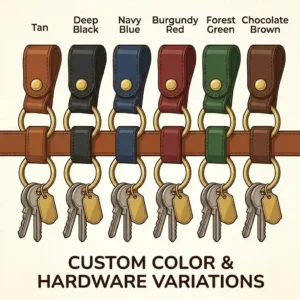
Full-Grain Leather
-
The Reality: Leather is a biological material. It breathes, absorbs moisture, and scars.
-
The Expert Take: Leather provides the best acoustic dampening and ergonomic comfort because it physically molds to your hip. However, if you work in a high-humidity environment or sweat heavily, the salt will dry out the leather. You must treat it with a leather balm twice a year. It’s best for tradesmen, office workers, and EDC purists.
Ballistic Nylon (1000D)
-
The Reality: Originally developed for military flak jackets, 1000D nylon is synthetic, hydrophobic, and virtually tear-proof.
-
The Expert Take: Nylon won’t stretch or rot, making it perfect for marine environments, hiking, or tactical use. The downside? It is abrasive. The stiff edges of a nylon loop will eventually cause pilling on softer fabrics like wool or fine cotton. Keep nylon away from your expensive suits.
Stainless Steel & Titanium
-
The Reality: Metal clips rely on spring tension and metallurgical memory.
-
The Expert Take: Metal is unaffected by sweat, rain, or mud. It is incredibly low-profile. But beware of cheap “zinc alloy” or “pot metal” products on Amazon. They look like steel but will snap under pressure. Stick to carbon steel, stainless steel, or titanium. The main drawback to metal is friction—it will eventually leave a permanent indentation or scrape on the top edge of your leather belts.
⏳ Long-Term Cost & Maintenance: A One-Year Roadmap
What happens to your gear after 3, 6, and 12 months of daily use? Let’s calculate the Total Cost of Ownership and look at the “Efficiency Gap.”
Month 1 to 3: The Honeymoon & Break-in
During the first 90 days, your gear will function flawlessly. Leather will begin to soften and take on the shape of your belt. Nylon might have some loose threads fraying at the edges (which you should carefully singe with a lighter). Metal clips will leave their first permanent groove in your belt.
-
Maintenance task: Burn off stray nylon threads; check screw tightness on any metal rigs with Loctite.
Month 6: The Tension Test
By month six, cheap gear reveals itself. Faux leather (PU leather) will start peeling at the edges. Cheap retractor springs will lose their final 10% of pull strength, leaving your keys dangling an inch below the housing.
-
Maintenance task: If using leather, apply your first coat of conditioner. If using a retractor like the Key-Bak, pull the string out completely and wipe it down with a damp cloth to remove abrasive dust that damages the internal coil.
Month 12 & Beyond: True ROI
If you bought a $5 gas station carabiner, you’ve likely replaced it three times by now, costing you $15 and massive frustration. If you invested $35 in a Tale of Knives loop or $20 in a Key-Bak, it is just hitting its prime. The Total Cost of Ownership for high-end carry gear is actually lower over a 3-year period than buying disposable, cheap clips.
✨ Don’t Miss These Exclusive Deals!
🔍 Ready to upgrade your EDC? Click on any highlighted item to check current pricing and availability. These tools will help you create an authentic, reliable carry system you will love!
🏁 Conclusion
Upgrading your daily carry isn’t about spending a fortune; it’s about making calculated, functional choices that eliminate daily friction. A reliable belt loop key holder is a small investment that pays massive dividends in convenience, security, and peace of mind.
Whether you need the relentless industrial utility of the Key-Bak SUPER48 for your facility management job, the heirloom-quality aesthetic of the Tale of Knives Leather Loop, or the tactical security of the Roaring Fire, the key is matching the tool to your specific environment. Stop trusting your car and house keys to a $2 piece of plastic. Measure your belt, assess your key weight, and invest in a retention system that will actually do its job for years to come.
❓ FAQs
❓ What is the most secure way to carry keys?
✅ Attaching a high-quality belt loop key holder to a sturdy leather or nylon belt is generally the most secure method. It removes keys from shallow pockets where they can fall out when sitting, and securely anchors them directly to your body’s center of gravity…
❓ Can a belt loop key holder damage my belt?
✅ Yes, depending on the material. Stiff metal clips can scuff or compress the edges of soft leather belts over time. To prevent this, opt for leather loops with snap closures that wrap gently around the belt rather than biting into it…
❓ How much weight can a retractable key holder handle?
✅ Most standard retractors handle 2-4 ounces, but heavy-duty models like the Key-Bak SUPER48 can reliably retract up to 8 ounces (roughly 15 standard keys). Exceeding the weight limit will cause the cord to sag and damage the internal spring…
❓ Is ballistic nylon better than leather for key loops?
✅ It depends on the environment. Ballistic nylon offers superior water and tear resistance, making it ideal for outdoor and tactical use. Leather offers better acoustic dampening, molds to your body, and looks far more professional in office settings…
❓ How do I stop my keys from jingling on my belt?
✅ You can silence key jingle by adding rubber key covers, using a compact key organizer (which bolts keys together into a single block), or tucking the dangling keys into your back pocket while the main ring remains securely clipped to your belt…
📚 Recommended for You
- 5 Best unique keychains of 2026: Stop Pocket Bulge Fast
- 5 Best ring key ring Upgrades for 2026 (Expert EDC Tested)
- 5 Best Belt Key Holder Options for 2026: Expert EDC Field Test & Review
Disclaimer: This article contains affiliate links. As an Amazon Associate, I earn from qualifying purchases. If you purchase products through these links, we may earn a small commission at no additional cost to you.
✨ Found this helpful? Share it with your friends! 💬🤗
[addtoany]
